
Hottest Air Filter Types in 2026: A Buyer's Market Reference
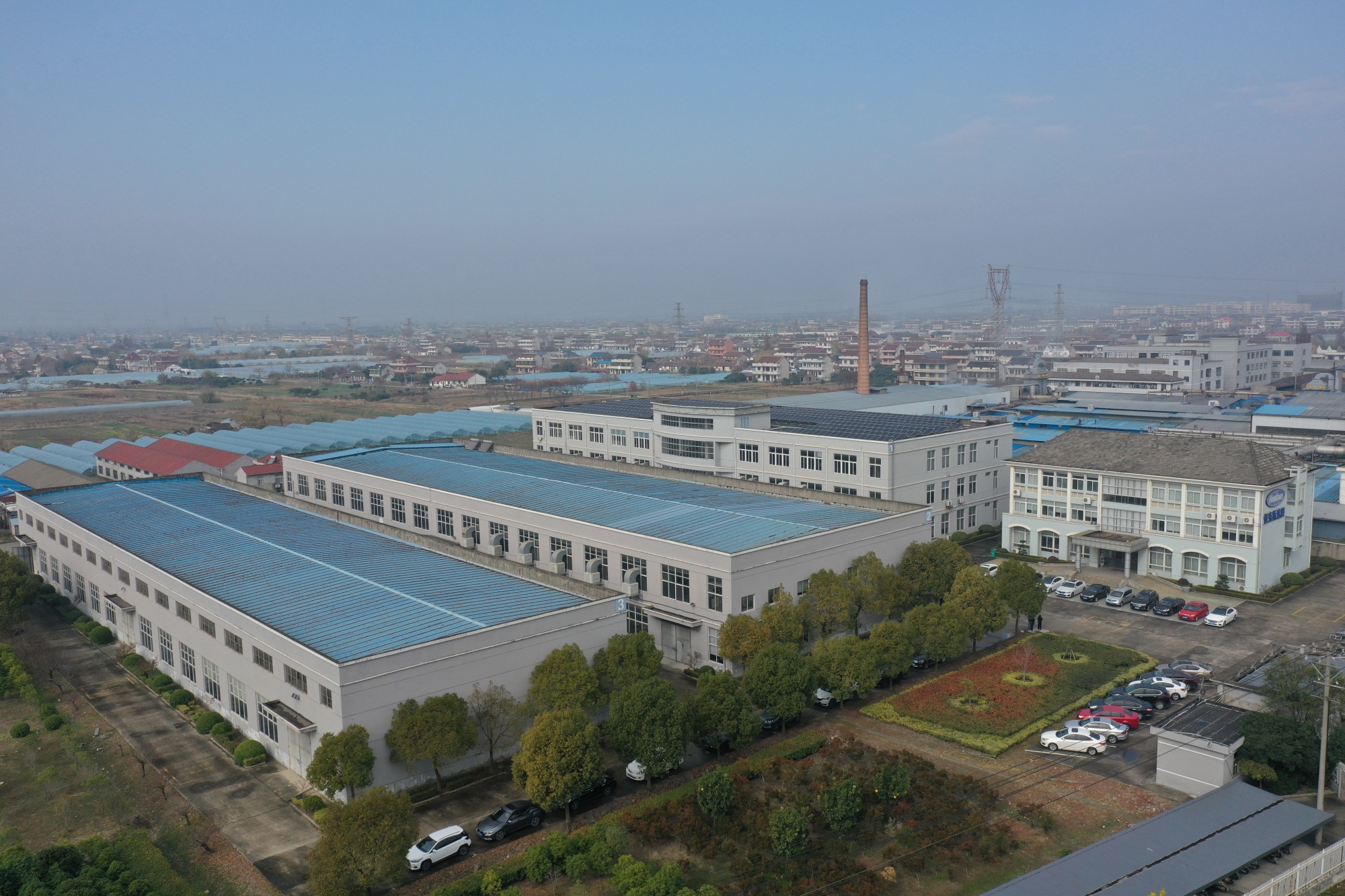
The global air filter market was valued at USD 17.08 billion in 2025 and is projected to reach USD 34.66 billion by 2034, according to Fortune Business Insights. Behind that headline growth, procurement teams are facing a more specific challenge: knowing which air filter types will deliver the most value for their application. Demand is now visibly split across household air purification, commercial HVAC, cleanroom, hospital, and fresh air ventilation segments. Each segment favors different filter technologies, efficiency grades, and testing standards.
This reference article is designed for buyers at the evaluation stage. It explains the air filter types with the highest demand momentum in 2026, links each type to concrete application data, and provides a step-by-step decision workflow supported by manufacturing evidence from Nantong Henka Environment Solutions Co., Ltd (Henkaes).
Buyers and the Air Filter Type Selection Dilemma
Evaluation-stage buyers often begin with supplier audits, certifications, and pricing. But the first technical decision should be the filter type itself. A mismatch can be costly in several ways. An undersized filter may clog quickly and increase maintenance. An oversized HEPA solution in a commercial air handling unit can raise energy costs unnecessarily. A hospital project that needs higher-efficiency final filtration cannot be served by a pre-filter panel alone.
In 2026, buyers are also seeing wider variety in what an "air filter" can be: a household air purifier filter, an HVAC air filter, a cleanroom air filter, or a fresh air system component. The question is no longer simply "which brand" but "which type of filter is technically appropriate for this application, and which suppliers can produce it consistently."
What Is Driving Demand for Specific Air Filter Types in 2026?
Market data shows a clear shift toward application-specific filtration.
According to Grand View Research, the smart air purifier market is growing at a compound annual growth rate of 14.1% from 2024 to 2030, supported by AI and IoT integration. That growth directly expands the volume of household air purifier filters consumed as replacements and as original equipment. The same research firm reports that HEPA filters held a 41.7% share of the air purifier technology segment in 2025, making HEPA the dominant filtration technology in residential purification.
Standards also shape demand. In Europe, EN 1822 classifies HEPA and ULPA filters based on efficiency at the Most Penetrating Particle Size, with H14 requiring 99.995% efficiency. In North America, ASHRAE 52.2 classifies HVAC filters from MERV 1 to MERV 16 based on their ability to capture particles between 0.3 and 10 micrometers. A supplier that serves both markets needs to manage efficiency grades across both classification systems.
At the corporate level, large filtration groups continue to influence the market. Parker Hannifin led the industrial filtration systems market with a 15.7% share in 2024, according to Global Market Insights. Daikin Industries' filtration revenue reached USD 1.12 billion in 2024, with attention focused on high-end MERV 15 and HEPA products, according to Report Prime. For mid-sized buyers and OEM/ODM programs, the practical implication is that high-efficiency and application-specific filter types are becoming mainstream rather than premium exceptions.
Six Air Filter Types with High Demand in 2026
The categories below are drawn from Henkaes product and application documentation for North American and European buyers. For each type, we look at efficiency grade, materials, typical applications, and the demand signal driving procurement.
1. True HEPA Air Filter (≥99.97%)
True HEPA air filter media remains the most frequently specified option for household air purifier filters. In 2025, HEPA technology captured the largest share of the air purifier segment. Henkaes produces True HEPA filters with an efficiency grade of ≥99.97%, using fiberglass and polypropylene (PP). These filters are designed for household appliances such as air purifiers and air cleaners.
Buyers prefer True HEPA because it provides accountable fine-particle performance that can be verified by laboratory testing. For brands selling in North America and Europe, True HEPA is now the expected baseline in residential purification, not a special upgrade.
2. HEPA Air Filter (H13)
H13 is one of the most commonly applied HEPA efficiency grades in household and HVAC equipment. Henkaes lists H13 for household air purifier applications, with fiberglass and polypropylene media. H13 also appears in V-bank filters used in commercial and public buildings such as airports, hotels, museums, and restaurants.
For procurement teams, H13 offers a practical balance between high-efficiency performance and system pressure constraints. It is a useful reference grade when a buyer wants HEPA-level filtration without specifying a True HEPA label.
3. Activated Carbon Air Filter (CTC70–CTC100)
Activated carbon filters respond to growing demand for odor and gas removal in indoor environments. Henkaes produces activated carbon filters with CTC grades from CTC70 to CTC100, using quality activated carbon materials for household air purifier filters.
CTC grade is a common indicator of activated carbon adsorption capacity. Buyers choose higher grades when the target environment has heavier gaseous loads. For many residential brands, an activated carbon layer has become a standard companion to HEPA, because particulate filtration alone does not address formaldehyde, VOCs, or kitchen and pet odors.
4. VOC Air Filter (Activated Carbon + Special Catalyst)
When the application requires removal of specific volatile organic compounds, a standard carbon layer may not be sufficient. Henkaes VOC air filters use quality activated carbon plus a special catalyst to remove specific VOCs.
The product is used for purifying indoor air, with specific applications in formaldehyde removal and VOC removal. US market evidence supports this: one US ODM program running 50,000 pieces for formaldehyde removal maintained stable performance for two years, and another US ODM program for VOC removal in indoor air purification remained stable for one year. These are not niche academic cases; they reflect recurring buyer preference for gas-phase filtration in residential and light-commercial products.
5. Cleanroom Air Filter (U14/U15)
Data centers, microelectronics, and other cleanroom environments require filtration above conventional HEPA grades. Henkaes cleanroom air filters are available at U14/U15 efficiency grades, using micro-fiberglass and PTFE media.
U14 and U15 filters are demanded by projects where airborne contamination control has direct product-yield or operational-risk impact. The growth of semiconductor and electronics manufacturing continues to make cleanroom air filters one of the most technically sensitive procurement categories.
6. HVAC Air Filters: Panel G1–G4, Bag F5–F9, Furnace MERV 8/11/13, V-Bank H13, and Box MERV 15/16
Commercial and public buildings such as airports, hotels, museums, and restaurants typically use a staged filtration approach. Henkaes covers this range with several HVAC air filter families:
- Panel filters at G1–G4 efficiency grades, made from fiberglass and polypropylene (PP), serve as pre-filters in air handling systems.
- Bag filters at F5, F6, F8 and F9 efficiency grades, made from micro-fine fiberglass, are common intermediate filters for commercial HVAC.
- Furnace air filters are offered at MERV 8, MERV 11 and MERV 13, using polypropylene media.
- V-bank filters are available at H13 efficiency, using fiberglass and polypropylene media.
- Box filters at MERV 15 and MERV 16, using micro-fiberglass, are applied in pharmaceutical plants, hospitals, and food and beverage production sites.
This lineup gives buyers a clear selection path. For routine commercial comfort, MERV 8 to MERV 11 furnace filters provide mid-range performance. For healthcare and pharmaceutical environments, MERV 15/16 box filters provide the higher-efficiency final barrier. For fresh air ventilation systems, compact high-capacity designs such as V-bank filters support the growing fresh air segment in both residential and commercial projects.
Step-by-Step Workflow: Matching Air Filter Types to 2026 Projects
Buyers can apply a practical five-step workflow when evaluating air filter types for a specific program.
- Identify the regional standard. For European projects, verify that the filter efficiency is expressed in EN 1822 / ISO 29463 terms; H14 requires 99.995% efficiency at MPPS. For North American projects, use ASHRAE 52.2 MERV ratings from 1 to 16.
- Define the application environment. Household air purifier filters, HVAC air filters, cleanroom air filters, hospital air filters, and fresh air system filters have different performance goals. Select the category that matches the end-use environment.
- Identify target pollutants. If the concern is fine particles, specify HEPA, True HEPA, or MERV-rated media. If the concern is formaldehyde, VOCs or odor, add activated carbon or a VOC filter with a special catalyst.
- Select efficiency grade and material. Review grades such as G1–G4, F5–F9, MERV 8, MERV 11, MERV 13, H13, U14/U15, and materials such as fiberglass, polypropylene, micro-fiberglass, PTFE, and activated carbon. Each combination should match the system's airflow, pressure drop, and expected lifetime.
- Verify supplier capability. Confirm that the manufacturer can produce the required type at scale, with documented quality control and application evidence. Key indicators include monthly capacity, lead time, inspection process, test chambers, and certification scope.
Real-World US Use Cases in OEM/ODM Air Filter Supply
Market preference is also visible in actual OEM and ODM programs. Henkaes has documented multi-year supply relationships with US customers.
One US ODM program ordered 50,000 air filters specifically for formaldehyde removal. The product has maintained stable performance for two years, with the key highlight being good formaldehyde removal performance. This aligns with demand for gas-phase filtration in indoor air purifier applications.
A second US ODM program also used 50,000 filters for indoor air purification, with a focus on removing VOCs. The project has been stable for one year, and the key performance highlight is good VOC removal. This is the same pattern that procurement teams are seeing across residential and light-commercial product categories.
A third US OEM program sourced 20,000 filters for indoor air purification. The project remained stable for one year, with high efficiency as the primary highlight. Together, these projects illustrate that US buyers are consistently requesting high-efficiency media, formaldehyde/VOC removal capability, and long-term supply reliability.
Henkaes has worked with a US engineering team for more than 20 years. This enables the company to design filters from customer specifications, drawings, samples, or even early-stage ideas, and to provide engineering samples before mass production.
Air Filter Type Comparison Table: 2026 Quick Reference
The following table summarizes the air filter types discussed above. All grades, materials, and applications are based on Henkaes product documentation.
| Filter Type | Efficiency Grade | Materials | Typical Applications |
|---|---|---|---|
| True HEPA Air Filter | ≥99.97% | Fiberglass, Polypropylene (PP) | Household air purifiers, air cleaners |
| HEPA Air Filter | H13 | Fiberglass, Polypropylene (PP) | Household appliances; V-bank filters for commercial buildings |
| Activated Carbon Air Filter | CTC70, CTC80, CTC90, CTC100 | Quality activated carbon | Household air purification, odor and gas control |
| VOC Air Filter | Special catalyst | Activated carbon + special catalyst | Indoor environments; formaldehyde and VOC removal |
| Cleanroom Air Filter | U14/U15 | Micro-fiberglass, PTFE | Data centers, microelectronics, cleanrooms |
| Panel Filter | G1–G4 | Fiberglass, Polypropylene (PP) | Commercial and public buildings |
| Bag Filter | F5, F6, F8, F9 | Micro-fine fiberglass | Commercial and public buildings |
| Furnace Air Filter | MERV 8, MERV 11, MERV 13 | Polypropylene (PP) | Commercial and public buildings; HVAC systems |
| V-Bank Filter | H13 | Fiberglass, Polypropylene (PP) | Commercial and public buildings; fresh air systems |
| Box Filter | MERV 15, MERV 16 | Micro-fiberglass | Pharmaceutical plants, hospitals, food and beverage production sites |
FAQ: Questions Buyers Ask When Evaluating Air Filter Types
1. Which air filter standards should a 2026 buyer verify first?
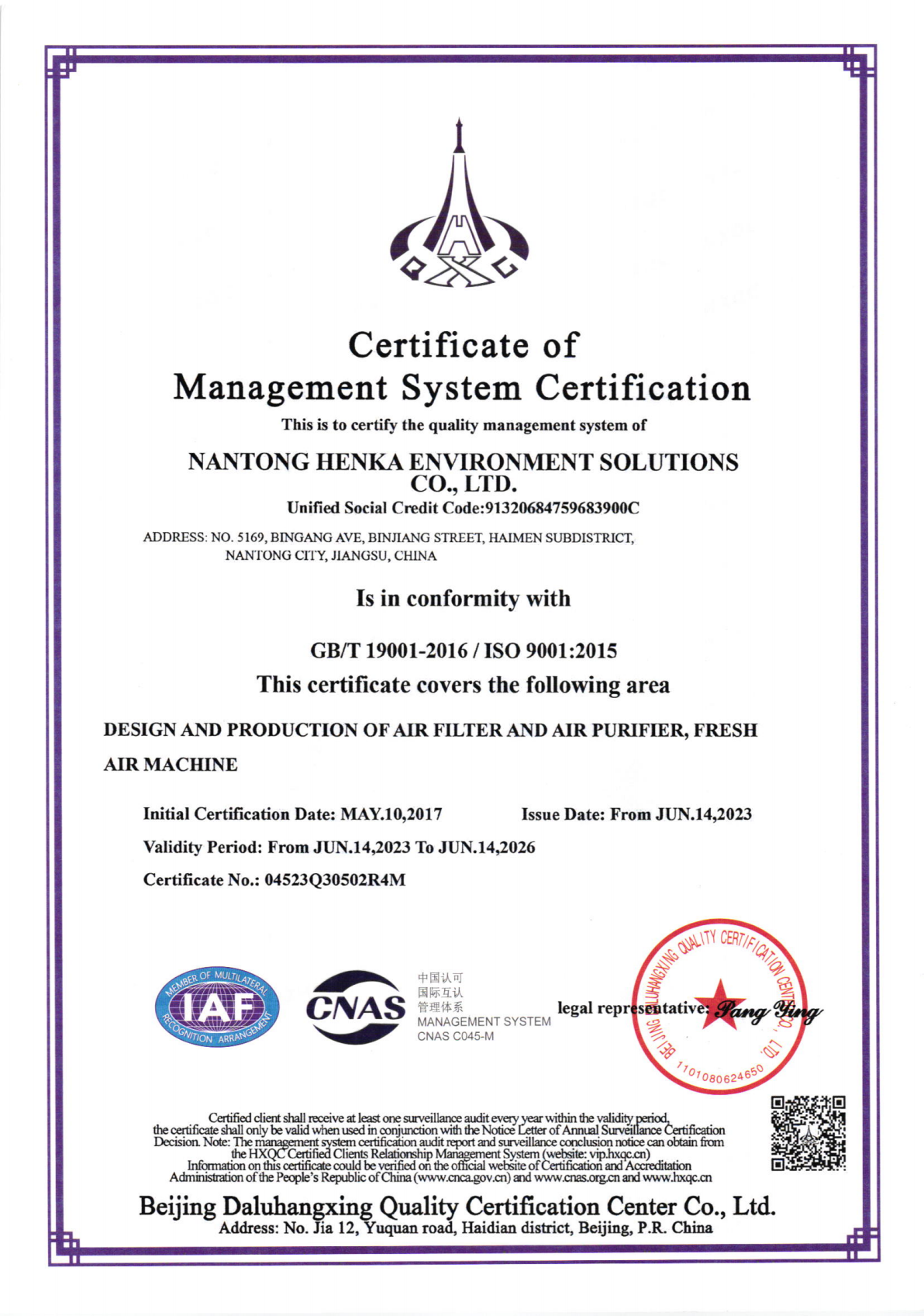
Buyers should first confirm which efficiency classification applies to the destination market. In Europe, EN 1822 classifies HEPA and ULPA filters based on efficiency at MPPS, with H14 requiring 99.995% efficiency. In North America, ASHRAE 52.2 classifies filters from MERV 1 to MERV 16 based on particle capture between 0.3 and 10 micrometers. At the supplier level, certification to ISO 9001:2015, ISO 14001:2015 and ISO 45001:2018 provides evidence that the factory has management systems for quality, environment, and occupational health. Henkaes holds these certifications, and its factory uses ASHRAE 52.2 in air filter testing, along with a 30 m³ test room for formaldehyde and VOC removal efficiency, a CADR test room for air purifiers, a noise test lab, and an efficiency and air resistance test system for filter media.
2. How can buyers verify that an OEM/ODM supplier can support high-volume 2026 programs?
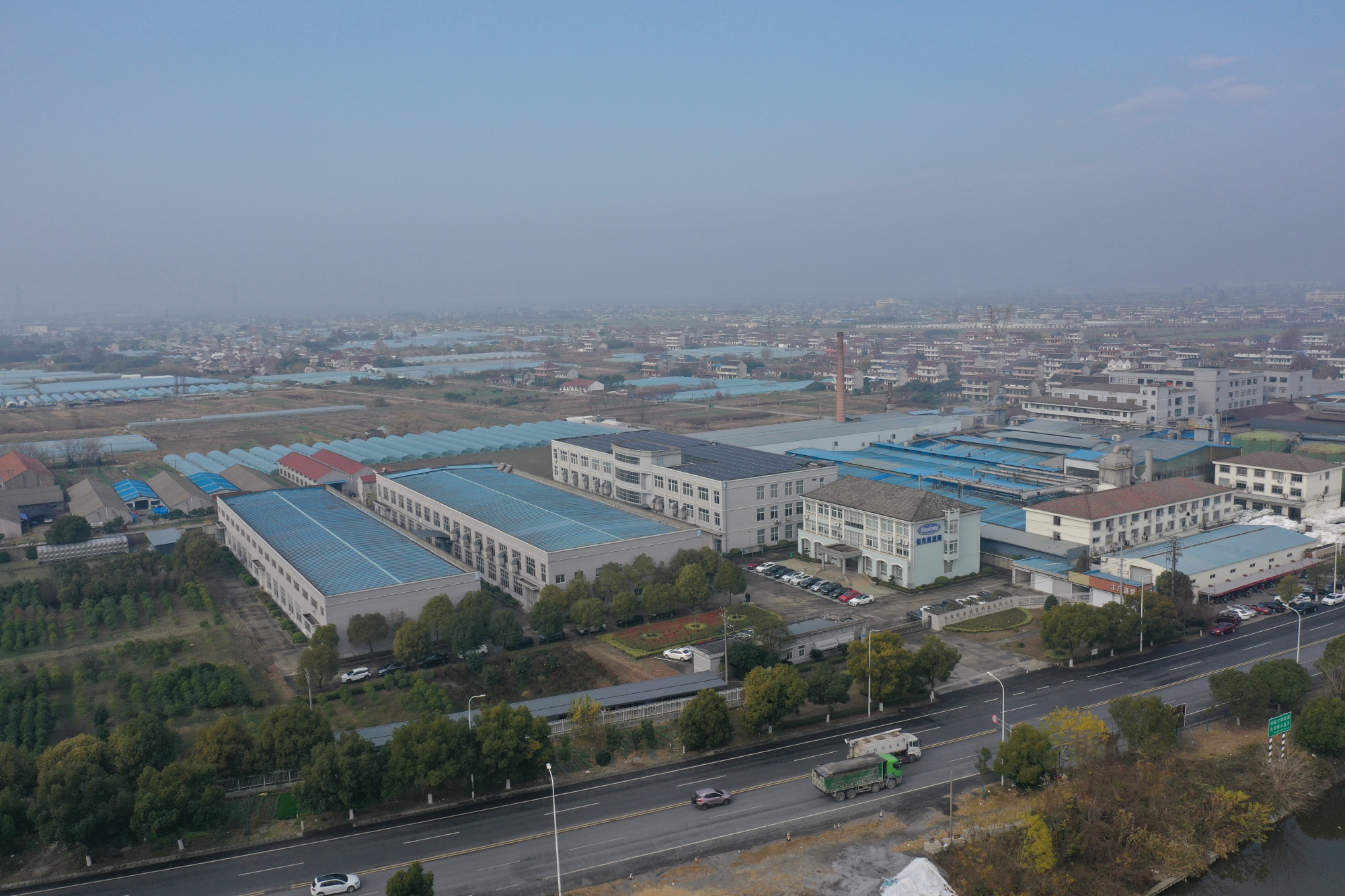
Capacity and evidence are the two decisive factors. Buyers should check monthly capacity, minimum order quantity, lead time, and inspection procedures. Henkaes operates a 30,000 m² factory with annual output of approximately 2,000,000 pieces, monthly capacity of 200,000 pieces, minimum order quantity of 500 pieces, and a lead time of 30 days. All products undergo 100% inspection, supported by remote after-sales support. The company exports about 69% of output to the EU and USA, and US customers have maintained stable programs with 20,000 to 50,000-piece orders over one to two years.
3. Which specifications have the highest impact on air filter budget?
Three specifications drive most of the cost: efficiency grade, filter media, and the presence of a gas-phase removal layer. A True HEPA filter at ≥99.97% or an H13-grade HEPA filter typically costs more than a MERV 8 furnace filter. Activated carbon filters are selected by CTC grade, from CTC70 to CTC100. A VOC filter with a special catalyst adds capability for formaldehyde and VOC removal. Buyers should match the specification to the actual environment instead of over-specifying higher grades than the application requires.
4. How do buyers obtain engineering samples before production?
The standard path is to submit drawings, specifications, reference samples, or a product idea, and ask the manufacturer to produce engineering samples for testing. Henkaes provides complete engineering design services, including design of various filter specifications, production of engineering samples, production and testing, solid modeling, and rapid prototyping. The company has worked with a US engineering team for more than 20 years, so the sample stage is treated as a joint design process rather than a simple order confirmation.
5. What is the typical lead time once a custom filter design is approved?
Henkaes quotes a standard lead time of 30 days for production, with monthly capacity of 200,000 pieces across its OEM/ODM programs. Buyers with scheduled product launches should share target launch dates during the inquiry stage so material and production slots can be reserved. To confirm specifications, lead time, and budget for a 2026 program, buyers can contact Henkaes directly for a quote or request samples before mass production planning begins.
Conclusion: Build 2026 Filter Procurement Around Application Demand
The air filter market of 2026 is not one market. Household air purifier filters are being pulled by smart purification growth and gas-phase concerns. Commercial HVAC buyers are working with staged MERV and F-grade systems. Cleanroom and hospital projects are driving demand for U14/U15 and MERV 15/16 filters. The common thread is that buyers are selecting filter types more deliberately, and they expect suppliers to support the choice with engineering evidence and consistent production quality.
For evaluation-stage buyers, the practical next step is to translate the chosen application into filter grade, material, and certification requirements, then assess suppliers against those criteria. Henkaes offers documented experience across True HEPA, H13, activated carbon, VOC, cleanroom, and HVAC filter categories, with US project histories that demonstrate stable long-term supply.
Want to evaluate a specific filter type for your 2026 project? Download the Henkaes e-catalogue to review product families, dimensions, and custom options, or contact Peter Zhou at peter@airfilter-china.com for a quote.
View the Henkaes Air Filter E-Catalogue (PDF)
Website: www.airfilterodm.com
Have Questions or Need More Details?
Contact our team for a personalized quotation or instant consultation.
Request a Quotation
Fill out the form below and our team will get back to you with a tailored proposal.
WhatsApp Direct Chat
Prefer to chat in real-time? Message us on WhatsApp for instant assistance & quick answers.
- Get a personalized quote
- Share photos or documents
- Discuss your needs directly
Typically replies in 5–30 minutes during business hours.