
V-Bank and Bag Filter Maintenance: TCO FAQ for HVAC Buyers
HVAC Air Filter Maintenance & TCO FAQ
V-Bank filters rated H13 and bag filters rated F5–F9 do not share a universal maintenance calendar. They share a maintenance logic: protect the media, trend pressure drop, and replace on condition rather than on a fixed month count. In commercial and public buildings, the total cost of ownership of either filter is driven less by the unit price than by energy use, access labor, downtime, inventory, and the cost of getting the change-out wrong. This FAQ answers the maintenance and TCO questions buyers ask most often when comparing V-Bank H13 and Bag F5–F9 air filters.
Problem Definition: Why V-Bank and Bag Filter TCO Is Misread
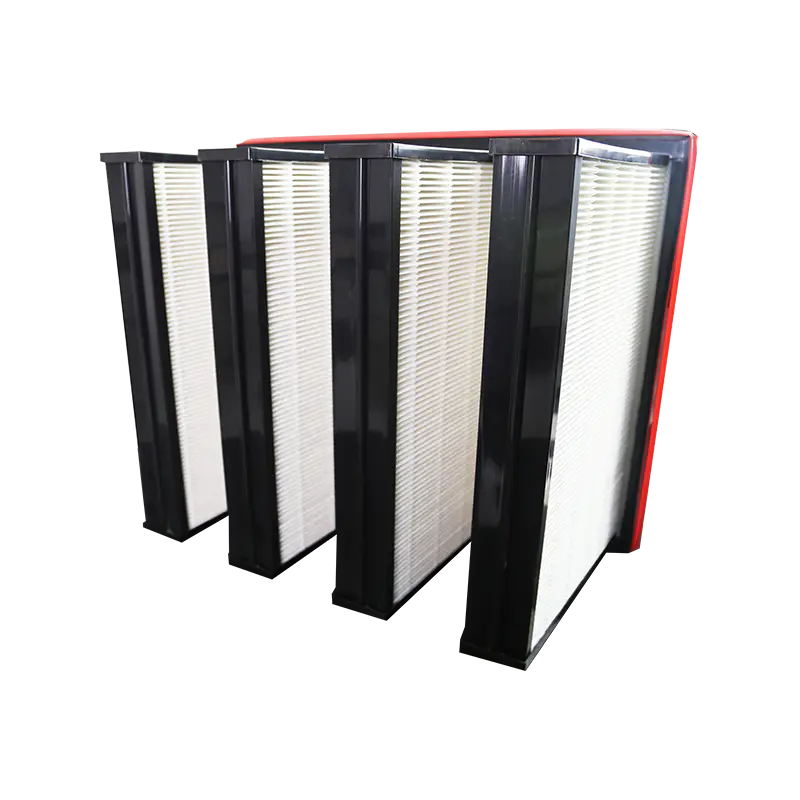
Buyers often put V-Bank and bag filters into the same tender because both are HVAC air filters for commercial and public buildings. The comparison then collapses into price per filter. That approach misses two facts. First, the products sit at different efficiency levels: V-Bank is H13; Bag is F5, F6, F8, or F9. Second, their media differ: V-Bank uses fiberglass and polypropylene (PP); Bag uses microfine fiberglass. Those differences change how the filter loads, how it is inspected, and what a safe replacement event costs.
The practical result is that a lower unit price can carry a higher lifecycle cost if pressure drop, labor, or downtime is managed poorly. A V-Bank H13 filter protects a high-efficiency stage, so a tear, a compressed gasket, or a bypass path can undermine the filtration objective. A bag filter protects downstream stages and manages loading, so a collapsed pocket or a poor frame seal can shift dust to the next filter. Both outcomes affect maintenance cost and system performance.
Industry Background: HVAC Filtration Stages and Standards
HVAC filtration in airports, hotels, museums, and restaurants is usually a staged system. A pre-filter protects downstream stages; a secondary or bag stage removes finer particles; a high-efficiency stage handles the most demanding requirement. V-Bank H13 and Bag F5–F9 can both appear in that chain, but they are not interchangeable positions. The V-Bank Filter is a HVAC Filtration product with efficiency grade H13, made of fiberglass and polypropylene (PP), and intended for commercial and public buildings such as airports, hotels, museums, and restaurants. The Bag Filter is a HVAC Filtration product with grades F5, F6, F8, and F9, made of microfine fiberglass, and intended for the same commercial and public building types.
Filter grades should be read with the standard framework in mind. ASHRAE Standard 52.2 classifies filters using MERV ratings from 1 to 16. MERV 11 is one point within that framework, but it is not automatically interchangeable with F5–F9 or H13 without a careful mapping check. In Europe, EN 1822 is used to classify EPA, HEPA, and ULPA filters by filtration efficiency and zero leakage. H13 sits in that high-efficiency family. For general ventilation filters, EN 779:2012 was replaced in Europe by ISO 16890 since mid-2018, while ASHRAE 52.2 remains a classification framework for MERV values. Bag grades F5–F9 are commonly written in the EN 779 framework, so a buyer should confirm which grade system is on the datasheet and in the maintenance file.
Detailed Solution: A Maintenance and TCO Model for V-Bank H13 and Bag F5–F9
V-Bank Filter H13: Protect the High-Efficiency Stage
For the V-Bank Filter, the H13 grade makes media protection the central maintenance issue. Inspect the frame, media pack, gasket, and seating for damage or bypass. Trend pressure drop from commissioning with the same gauge and airflow condition. A steady rise usually points to loading; a sudden drop can point to bypass, media damage, or a change in airflow. Where the project requires installed-filter integrity checks, record the method and result in the maintenance file. EN 1822 is the European classification framework for EPA, HEPA, and ULPA filters by filtration efficiency and zero leakage, and H13 sits in that high-efficiency family.
Do not assume cleanability from media type alone. Fiberglass and polypropylene (PP) construction does not by itself establish that a filter can be washed or reused. Confirm cleaning guidance with the supplier and the project specification. In TCO terms, the V-Bank H13 stage should be protected by upstream filtration; extending a loaded pre-filter or bag filter to save a replacement can increase the load on the H13 stage and raise the cost of the next change-out.
Bag Filter F5–F9: Manage Loading and Bag Integrity
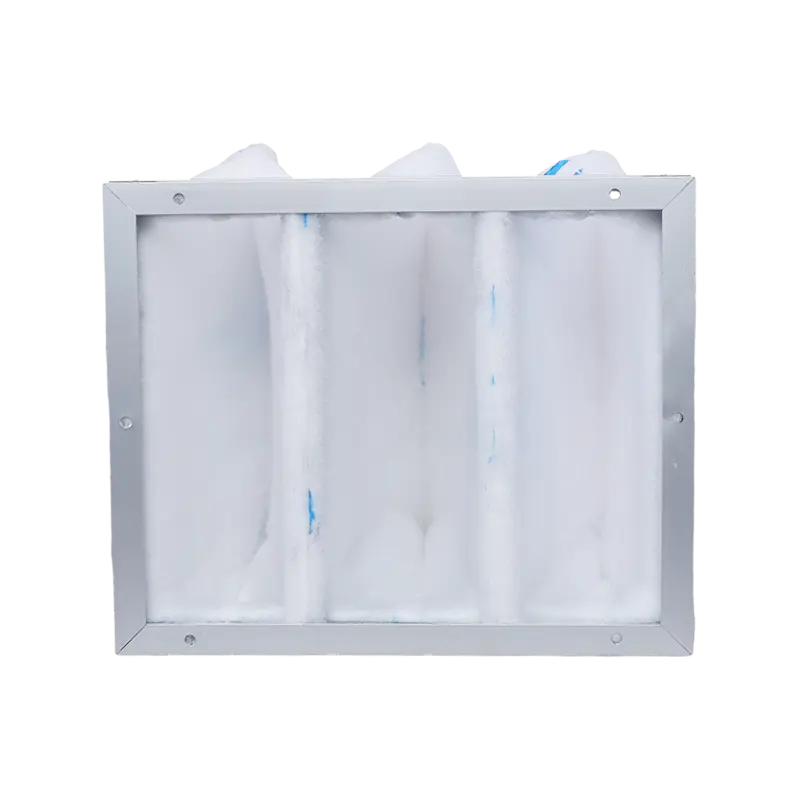
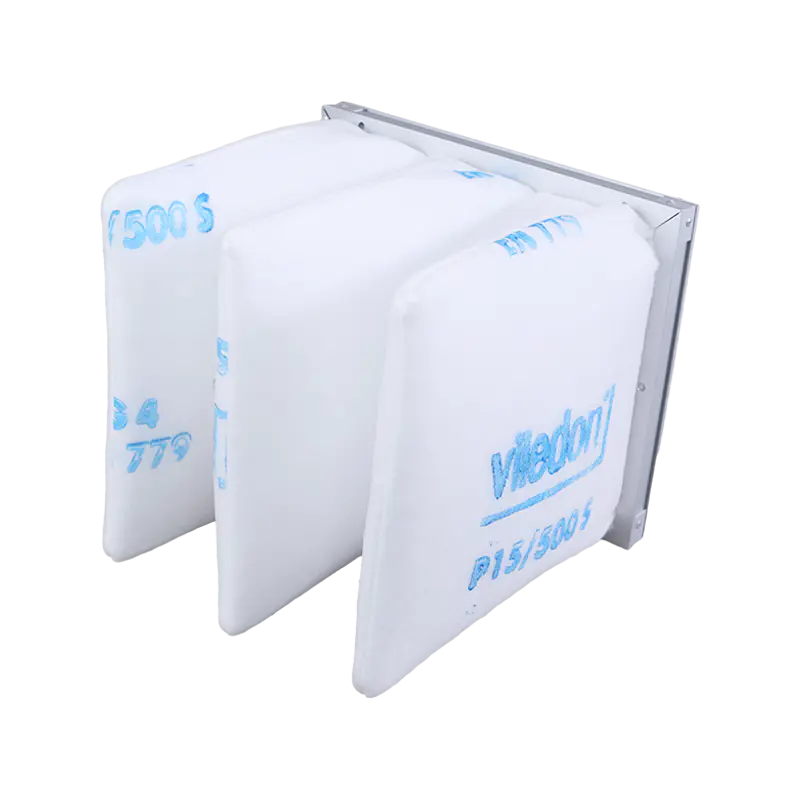
For the Bag Filter, maintenance attention shifts to pocket condition, frame seating, and loading distribution. Inspect pockets for tears, collapse, and uneven dust build-up. Confirm that the bag is seated and sealed; a small leak around the frame can load the downstream H13 stage. Grades F5, F6, F8, and F9 are commonly expressed in the EN 779 framework. Since mid-2018 EN 779 has been replaced by ISO 16890 in Europe, while ASHRAE 52.2 remains a MERV framework. The maintenance file should state which grade system the replacement is bought against, so that a replacement is not selected on a grade label alone.
Bag filters often present a larger media surface in a pocket format, but that does not remove the need to check pressure drop and sealing. A bag that is physically intact but poorly seated can still allow bypass. A bag that is heavily loaded can raise fan energy and reduce airflow. The TCO question is therefore not only “what does the bag cost?” but “what does the bag do to fan energy, access labor, and the next filter in the chain?”
The TCO Equation Buyers Should Use
Use a line-item model rather than a unit-price comparison. The main TCO lines for V-Bank H13 and Bag F5–F9 air filters are:
- Filter purchase price: quoted price per filter, plus minimum order quantity and packaging.
- Freight, duties, and inventory: shipping, customs, storage space, and capital tied up in stock.
- Fan energy: the operating cost created by average pressure drop over operating hours. Fan energy is a function of airflow, pressure drop, and fan efficiency; it is not set by the filter price alone.
- Labor: access, isolation, safe removal, gasket replacement, correct orientation, and record keeping.
- Downtime: shutdown coordination, temporary filtration, and commissioning time.
- Disposal and storage: handling of used filters and space for replacement stock.
- Quality and rework: inspection, rejection, replacement shipments, and site rework.
- Expediting risk: premium freight or temporary substitutes when stock runs out.
For H13, add the cost of any project-required integrity check. For bag filters, add the labor of handling multiple pockets and confirming frame seals. The comparison should use the same airflow, hours, energy rate, and labor rate for both options. If those inputs are missing, the result is not a TCO comparison; it is a price comparison with extra steps.
Step-by-Step Breakdown: Building a Maintenance and TCO Plan
- Map the filter chain and duty. Record every stage, grade, media, model, and position. Confirm where V-Bank H13 and Bag F5–F9 sit in the air handling system. A grade label without position is not enough for maintenance planning.
- Record baseline pressure drop at commissioning. Use the same gauge, tap location, and airflow condition for later readings. Record date, filter batch, and installer. Without a baseline, a pressure reading has little maintenance value.
- Set change-out triggers. Use the supplier’s final resistance guidance, fan capability, and project requirements. Add visual triggers: media damage, gasket failure, bypass, odor, or dust carryover. Do not rely on a calendar alone.
- Protect the H13 stage. Verify upstream bag and pre-filter condition. A loaded upstream stage increases the load on the H13 filter. Saving on pre-filtration can shift cost to the high-efficiency stage.
- Define inspection frequency by site. Use operating hours, occupancy, outdoor dust, and access windows. There is no universal interval. High-dust or long-hour sites need closer review than low-load sites.
- Build the TCO sheet. Use site airflow, operating hours, energy rate, labor rate, and quoted filter price. Run low, base, and high change-out scenarios. Include inventory carrying cost and lead time.
- Write the replacement procedure. Include isolation, safe access, gasket replacement, correct orientation, and record keeping. For H13, include any integrity check required by the project. For bag filters, include pocket inspection and frame seal confirmation.
- Review after each change-out. Compare actual pressure drop and labor hours with the plan. Update the interval, order quantity, and inspection checklist. Maintenance data should improve the next TCO calculation.
Use Cases: Commercial and Public Buildings
Airports
Airport terminals combine large air handling units, long operating hours, and public access. V-Bank H13 may be specified where high-efficiency filtration is required; Bag F5–F9 may serve as an upstream stage. TCO is sensitive to access windows and to the cost of bypass. Maintenance should coordinate with terminal operations and record pressure drop after each change-out. A filter change that disrupts a public area can cost more in coordination than the filter itself.
Hotels
Hotels balance guest comfort with back-of-house access. Bag filters can be distributed across many air handling units; V-Bank H13 may be limited to specific high-efficiency zones. The TCO risk is small filters multiplied across many units. Standardize records, check gaskets, and group replacement orders where practical. Confirm the grade system on each datasheet because hotel portfolios often mix equipment vintages.
Museums
Museums care about stable indoor conditions and protection of collections. H13 stages need media integrity and bypass control. Bag stages need consistent loading control. Maintenance records should be detailed enough for review by facilities, conservation, and HVAC teams. A pressure-drop trend and a visual checklist are more useful than a generic replacement month.
Restaurants
Restaurants have grease and odor sources, but V-Bank and bag filters in the HVAC air path are not a substitute for kitchen exhaust grease filtration. Keep the scope clear. For HVAC filtration, loading can be uneven; inspect for localized contamination and confirm the filter is appropriate for the air stream. In restaurant projects, maintenance access and cleaning schedules often determine the real replacement interval.
Comparison Table: V-Bank H13 vs Bag F5–F9
| Attribute | V-Bank Filter | Bag Filter |
|---|---|---|
| Product type | HVAC Filtration | HVAC Filtration |
| Efficiency grade | H13 | F5, F6, F8, F9 |
| Media | Fiberglass and polypropylene (PP) | Microfine fiberglass |
| Typical building types | Commercial and public buildings such as airports, hotels, museums, restaurants | Commercial and public buildings such as airports, hotels, museums, restaurants |
| Maintenance focus | Protect high-efficiency media, gasket, frame, and seating; check for bypass and media damage | Check pocket condition, loading distribution, frame seal, and bag seating |
| Replacement trigger | Pressure-drop trend, visual condition, upstream loading, project integrity requirements | Pressure-drop trend, visual condition, pocket damage, upstream loading |
| Standard reference to confirm | EN 1822 classification framework for EPA, HEPA, and ULPA filters | EN 779 framework for F5–F9; note EN 779 replaced by ISO 16890 in Europe since mid-2018 |
| TCO sensitivity | Media protection, integrity checks where specified, access labor, bypass risk | Loading control, pocket handling, frame sealing, fan energy, inventory |
FAQ: Maintenance and Total Cost of Ownership
1. Which standards should a maintenance file reference for V-Bank H13 and Bag F5–F9 filters?
V-Bank H13 sits in the EN 1822 classification framework for EPA, HEPA, and ULPA filters. Bag F5–F9 grades are commonly expressed in the EN 779 framework; since mid-2018 EN 779 has been replaced by ISO 16890 in Europe, while ASHRAE 52.2 remains a MERV framework. The maintenance file should record the grade system on the datasheet, the test method referenced by the supplier, and the replacement records. This prevents a replacement filter from being selected on a grade label that belongs to a different framework.
2. How often should V-Bank and bag filters be replaced?
There is no universal calendar interval. Replacement should be based on pressure-drop trend, visual condition, upstream pre-filter and bag loading, operating hours, contaminant loading, the supplier’s final resistance guidance, and project requirements. V-Bank H13 media is finer than F5–F9 bag media, so the H13 stage should be protected by appropriate upstream filtration. A sudden pressure change, visible damage, gasket failure, or bypass should trigger inspection and possible replacement before the next planned date.
3. What drives total cost of ownership for these filters?
The main TCO lines are filter purchase price, freight and duties, inventory carrying cost, fan energy from average pressure drop, access and replacement labor, downtime, disposal and storage, quality inspection, and expediting risk. Fan energy depends on airflow, pressure drop, and fan efficiency, not on filter price alone. For H13, add any project-required integrity check. For bag filters, add pocket handling and frame-seal verification. A lower unit price can be offset by higher energy use, more frequent access, or higher downtime.
4. Can buyers validate maintenance assumptions before a full order?
Henkaes provides design, engineering sample production, production, and testing services as part of its air filter supply. The company offers OEM&ODM production, size and logo customization, 100% inspection, a 30-day lead time, MOQ 500 PCS, and remote after-sales support. Buyers can request samples and current product information before setting a full replacement schedule. Use the sample to confirm fit, gasket condition, and the grade system on the datasheet, then validate the pressure-drop baseline on site.
5. What lead time and MOQ should buyers plan for replacement orders?
Henkaes states a 30-day lead time and an MOQ of 500 PCS, with a monthly capacity of 200,000 PCS and 100% inspection. The company exports to the EU and US. For project planning, confirm lead time and MOQ by specific V-Bank or Bag Filter SKU and order volume, then add site access time and safety stock to the maintenance plan. Replacement orders should be scheduled before the pressure-drop trigger is reached, not after a filter has already loaded beyond its useful range.
Conclusion: Decide on Lifecycle Cost, Not Unit Price
The maintenance answer for V-Bank H13 and Bag F5–F9 filters is not a single replacement month. It is a controlled process: know the grade system, establish a pressure-drop baseline, protect the H13 stage, inspect bag pockets and frame seals, and calculate TCO with energy and labor included. The V-Bank Filter is an H13 HVAC filter made of fiberglass and polypropylene (PP); the Bag Filter is an F5–F9 HVAC filter made of microfine fiberglass. Both are intended for commercial and public buildings such as airports, hotels, museums, and restaurants. Their maintenance plans should reflect those material and grade differences.
Henkaes is the brand of Nantong Henka Environment Solutions Co., Ltd, a China-based air filter manufacturer founded in 2004. The company operates a 30,000 m² facility, employs 63 people including 11 engineers, and reports annual output of 2,000,000 pcs, with 69% of output exported to the EU and US. Henkaes uses ASHRAE 52.2 in air filter testing and provides OEM&ODM air filter production, size and logo customization, 100% inspection, a 30-day lead time, MOQ 500 PCS, and remote after-sales support.
Next step: Review the Henkaes air filter catalogue and request a sample or quotation for V-Bank H13 or Bag F5–F9 filters. Confirm the grade system, gasket configuration, and replacement volume before finalizing the maintenance budget.
Download the Air Filter Catalogue
Email: peter@airfilter-china.com · Website: www.airfilterodm.com · WhatsApp: +86 138-1376-6750
Address: No 5169, Bin'gang Ave, Binjiang Subdistrict, Haimen District, Nantong City, Jiangsu Province, China 226113.
Have Questions or Need More Details?
Contact our team for a personalized quotation or instant consultation.
Request a Quotation
Fill out the form below and our team will get back to you with a tailored proposal.
WhatsApp Direct Chat
Prefer to chat in real-time? Message us on WhatsApp for instant assistance & quick answers.
- Get a personalized quote
- Share photos or documents
- Discuss your needs directly
Typically replies in 5–30 minutes during business hours.