
Panel Filter vs. Bag Filter: Choosing the Right Pre-Filtration Strategy
Pre-filtration decision guide for commercial & public buildings | Henkaes Technical Reference
Pre-filtration is the lowest-cost stage in an HVAC filtration chain and the one that sets the cost of every stage behind it. In a commercial or public building, the first filter in the air handling unit decides how much particulate matter reaches the coils, the fan, and the higher-grade filters downstream.
This guide compares the two filters most often used to carry that duty: Panel Filter (efficiency grade G1–G4) and Bag Filter (efficiency grade F5–F9). Both sit in the HVAC Filtration product line manufactured by Henkaes — the brand of Nantong Henka Environment Solutions Co., Ltd, an air filter manufacturer founded in 2004 in Haimen, Jiangsu Province, China. They share the same target industry — commercial and public buildings such as airports, hotels, museums, and restaurants — but they solve different problems. The question this article answers is not which filter is better, but at what point the extra filtration capability of a bag filter starts paying for itself, and at what point a panel filter is simply the correct, lower-cost answer.
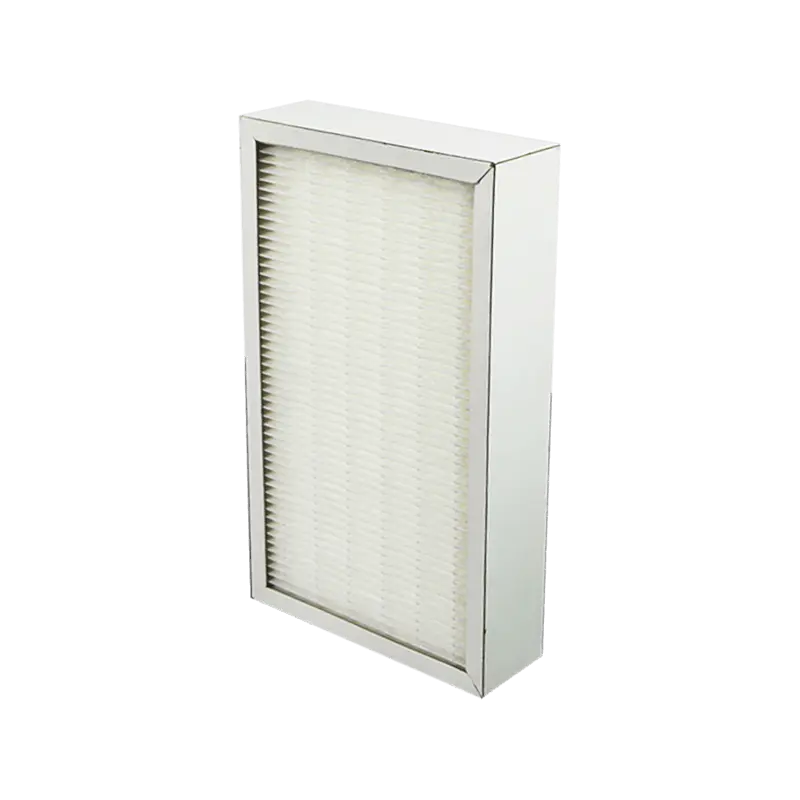
Panel Filter, efficiency grade G1–G4, glass fiber and polypropylene construction — the first stage of a commercial HVAC filtration chain.
Why the Pre-Filtration Decision Goes Wrong
Pre-filtration errors rarely come from a lack of knowledge about filtration. They come from mispositioning the stage.
- Specifying too low. If the first stage lets too much particulate through, coils, drain pans, and the next filter stage load up faster. The replacement cost moves from a low-cost panel filter to a considerably more expensive component.
- Specifying too high. An over-specified pre-filter brings higher resistance and more frequent change-outs. The fan has to work against something it did not need to work against, and maintenance labor rises with every change.
- Mixing standards. A buyer who specifies by one classification framework, sources by a second, and verifies by a third can believe they are comparing like with like when they are not. This is the most common hidden cause of a pre-filtration mismatch.
The practical consequence is that the pre-filter stage becomes either a bottleneck for maintenance or a bottleneck for downstream component life. Both outcomes are avoidable, because they are decided before the order, not after installation.
Industry Background: What G1–G4 and F5–F9 Actually Mean
Understanding the grade band requires understanding which framework produced it. Air filter classification is not a single global system, and the frameworks answer different questions.
ASHRAE Standard 52.2 classifies filters using MERV ratings from 1 to 16. It is a general ventilation filter classification framework, and the MERV value is derived from the performance efficiency calculated from synthetic-dust loading tests.
EN 1822 operates in a different band entirely. In Europe, EPA, HEPA, and ULPA filters are classified under EN 1822 for filtration efficiency and zero leakage. It does not describe the coarse or medium pre-filtration range.
EN 779 is the framework that produced the G and F grade letters. Since mid-2018, EN 779 has been completely replaced by ISO 16890 in Europe. That does not remove G1–G4 and F5–F9 from the market — it means buyers still encounter these grades in existing specifications, tender documents, and product ranges, while the regulatory reference in Europe has moved on. Anyone procuring cross-border should confirm which framework a quoted grade is actually referenced against.
Against that background, the two filters in this comparison occupy two distinct bands:
A Panel Filter at G1–G4 sits in the coarse band. It captures larger particulate — fibers, insects, and heavier dust — and its job is to shield what comes next rather than to deliver the final air quality result.
A Bag Filter at F5, F6, F8, or F9 sits in the medium band. It is still a pre-filter in a multi-stage chain, but it contributes real fine-particle removal of its own, which is why it is frequently the last stage before a high-efficiency filter.
Construction Differences That Drive the Decision
The grade gap between G and F is not an arbitrary label. It follows directly from construction.
The Henkaes Panel Filter is built from glass fiber and polypropylene (PP) in a flat configuration. The media is fixed inside a rigid frame with a defined face area, so the amount of filtration surface exposed to the air stream is limited to that face.
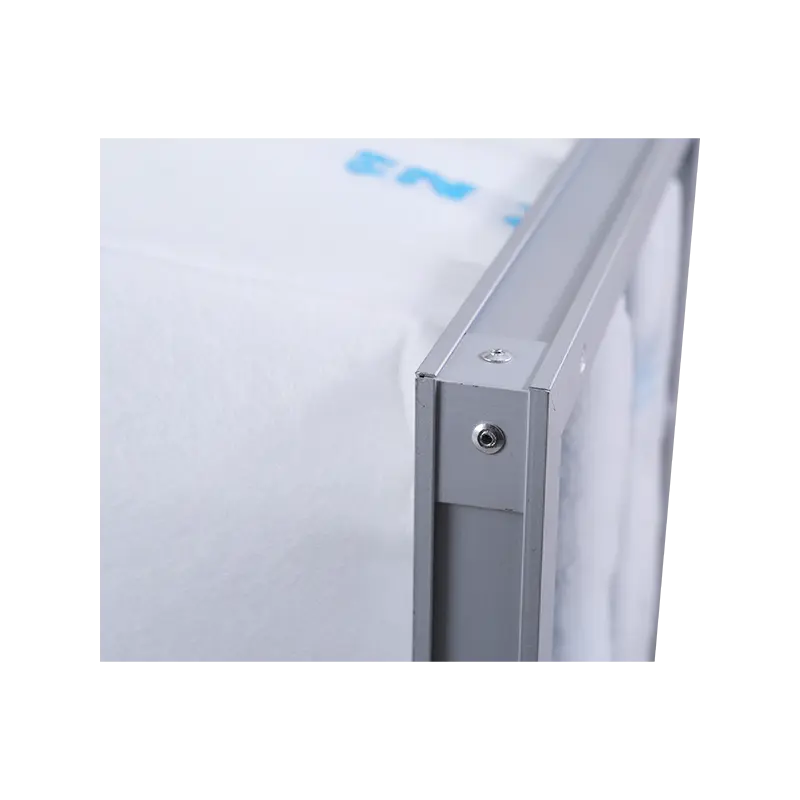
The Henkaes Bag Filter uses microfine fiberglass formed into a multi-pocket arrangement. The pockets extend into the air stream, so within the same frame footprint the available media area is substantially greater than a flat panel can offer.
That single structural difference produces the operational difference. With more media area, the air passes through at a lower face velocity for the same volumetric flow. Lower face velocity means the medium-band efficiency of F5–F9 can be sustained without a rapid resistance rise, and the filter holds more dust before it reaches its change-out point. A flat panel at G1–G4 cannot replicate this because it does not have the media area to work with — which is exactly why it belongs upstream of a bag filter rather than in its place.
Bag Filter, efficiency grade F5, F6, F8 and F9, microfine fiberglass media in a multi-pocket format.
Where Each Filter Fits in the Filtration Chain
Neither filter is the end of the chain in a commercial building. Henkaes' HVAC Filtration range continues past the pre-filter stage with the V-Bank Filter at H13, the Furnace Air Filter at MERV8, MERV11 and MERV13, and the Box Filter at MERV15 and MERV16 for pharmaceutical plants, hospitals, and food and beverage production sites. For cleanroom environments, the Cleanroom Air Filter reaches U14/U15 using microfiberglass and PTFE.
This matters to the pre-filtration decision because the demand placed on the first stage is set by what follows it. If the terminal stage is a MERV15/16 box filter, the pre-filter is protecting a high-value element and the case for F5–F9 strengthens. If the terminal stage is a moderate-efficiency filter serving a low-load space, a G1–G4 panel may carry the pre-filter duty adequately and at a lower cost.
Step-by-Step: Choosing the Right Pre-Filtration Strategy
The following sequence works through the decision in the order that prevents rework. Each step produces an input the next step needs.
Step 1 — Define what air quality the occupied space must reach. This is a building-level target, not a filter-level target. The pre-filter is only one contributor, and it should be specified once the target is known rather than before it.
Step 2 — Identify what sits downstream. List every filtration stage and every heat exchange component behind the first filter. High-value or HEPA-class downstream elements raise the cost of inadequate pre-filtration sharply.
Step 3 — Estimate the particulate load the installation will actually see. Where a building sits, how much outdoor air it draws, and how much foot traffic it handles all change the load profile. Airports and hotels with heavy outdoor air intake and constant occupancy sit at a very different point on that scale than a low-traffic museum wing.
Step 4 — Assess maintenance access and interval. If a filter bank is awkward to reach, a longer service interval has a real labor value and can justify a bag filter on maintenance grounds alone. If access is straightforward, the labor penalty of a shorter interval is correspondingly smaller.
Step 5 — Check the specification against the framework it was written in. A grade quoted as G or F should be traceable to the framework the project actually accepts. Where a project in Europe references current classification, confirm how the quoted grade maps before the order is placed rather than after delivery.
Step 6 — Validate with a physical sample. Filter selection done on paper misses installation realities: frame fit, gasket behavior, and actual resistance in the real air handling unit. A sample build removes that uncertainty before volume production.
Where a Panel Filter Is Enough — and Where It Is Not
The recommendation depends on the air quality requirement of the building, and that requirement drives three recognisable situations.
Situation A — Panel filter as the sole pre-filter. This applies where the downstream stage is itself responsible for fine-particle removal, the occupied spaces are low-load, and the filter bank is easy to service. The panel filter at G1–G4 does the job it was designed for: it stops the bulk of coarse particulate and lets the second stage work on the fine fraction. Specifying a bag filter here adds resistance and cost without changing the outcome in the room.
Situation B — Bag filter as the primary pre-filter. This applies where fine particulate loading is significant, where the filter bank sits behind difficult access, or where a high-efficiency terminal stage downstream needs protection that a coarse panel cannot give. Airports and hotels with continuous high outdoor air intake and heavy occupancy fall naturally into this group. Here the greater media area of the bag filter translates into a longer service interval and a more stable resistance profile, and the cost difference is recovered in maintenance and downstream protection.
Situation C — Panel filter and bag filter used together. This is the conventional cascade: a G1–G4 panel as the first coarse stage, an F5–F9 bag filter as the medium stage, and a high-efficiency stage after that. It is also the most frequently mis-specified arrangement, because buyers sometimes collapse the two stages into one when budget pressure appears — and the resulting single-stage design then has to perform two different jobs with one filter. Keeping the stages separate preserves the low-cost, easy-change role of the panel while letting the bag filter carry the fine-particle duty it is built for.
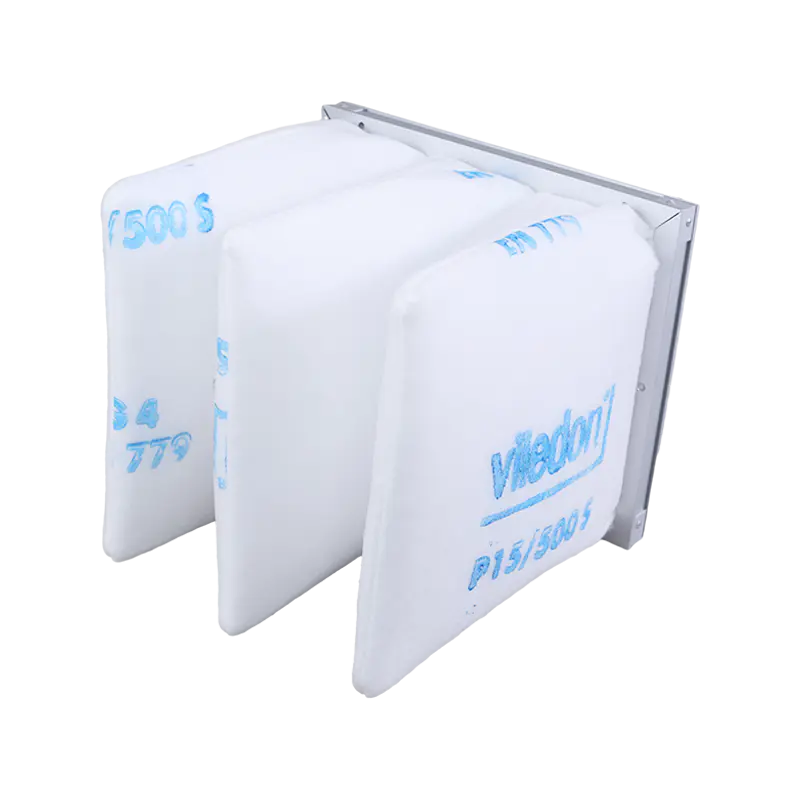
In a two-stage pre-filtration design, the bag filter carries fine-particle duty while the panel filter handles the coarse load.
Comparison Table: Panel Filter vs. Bag Filter
| Decision Dimension | Panel Filter | Bag Filter |
|---|---|---|
| Efficiency grade | G1–G4 | F5, F6, F8, F9 |
| Material | Glass fiber, polypropylene (PP) | Microfine fiberglass |
| Construction | Flat media in a rigid frame | Multi-pocket media extended into the air stream |
| Media area within the same frame footprint | Limited to the filter face | Substantially greater — pockets add usable media |
| Filter stage role | Coarse first stage; protects what follows | Medium stage; adds real fine-particle removal |
| Typical load condition | Lower particulate load, accessible filter bank | Higher fine-particle load, restricted access, or high-value downstream stage |
| Target industry | Commercial & public buildings: airports, hotels, museums, restaurants | Commercial & public buildings: airports, hotels, museums, restaurants |
| Product type | HVAC Filtration | HVAC Filtration |
Manufacturing and Compliance Context
Henkaes holds ISO9001:2015 certification, certificate number 04523Q30502R4M, issued by Beijing Dalu Hangxing Quality Certification Center Co., Ltd. and applicable to all markets, and ISO14001:2015 certification, certificate number 04523E30387R2M, issued by the same body and applicable to the global market. The company also states ISO45001:2018 certification covering the design and production of air filters, air purifiers, and fresh air machines.
The certification scope — design and production of air filter, air purifier, fresh air machine — is relevant to pre-filter procurement because it covers the engineering activity itself, not only the finished good. For a buyer specifying a G1–G4 panel or an F5–F9 bag filter to a project dimension, the ability of the supplier to design into a specification is part of what is being purchased.
Testing capability supports that. Henkaes operates an efficiency and air resistance test system for filter media, a noise test lab, a 30-cubic-meter test room for formaldehyde and VOC removal efficiency, and a CADR test room for air purifiers, and uses ASHRAE 52.2 in testing air filters. The company also references EN779, EN1822, ASHRAE 52.2, and ISO 16890 as test standards on its public materials.
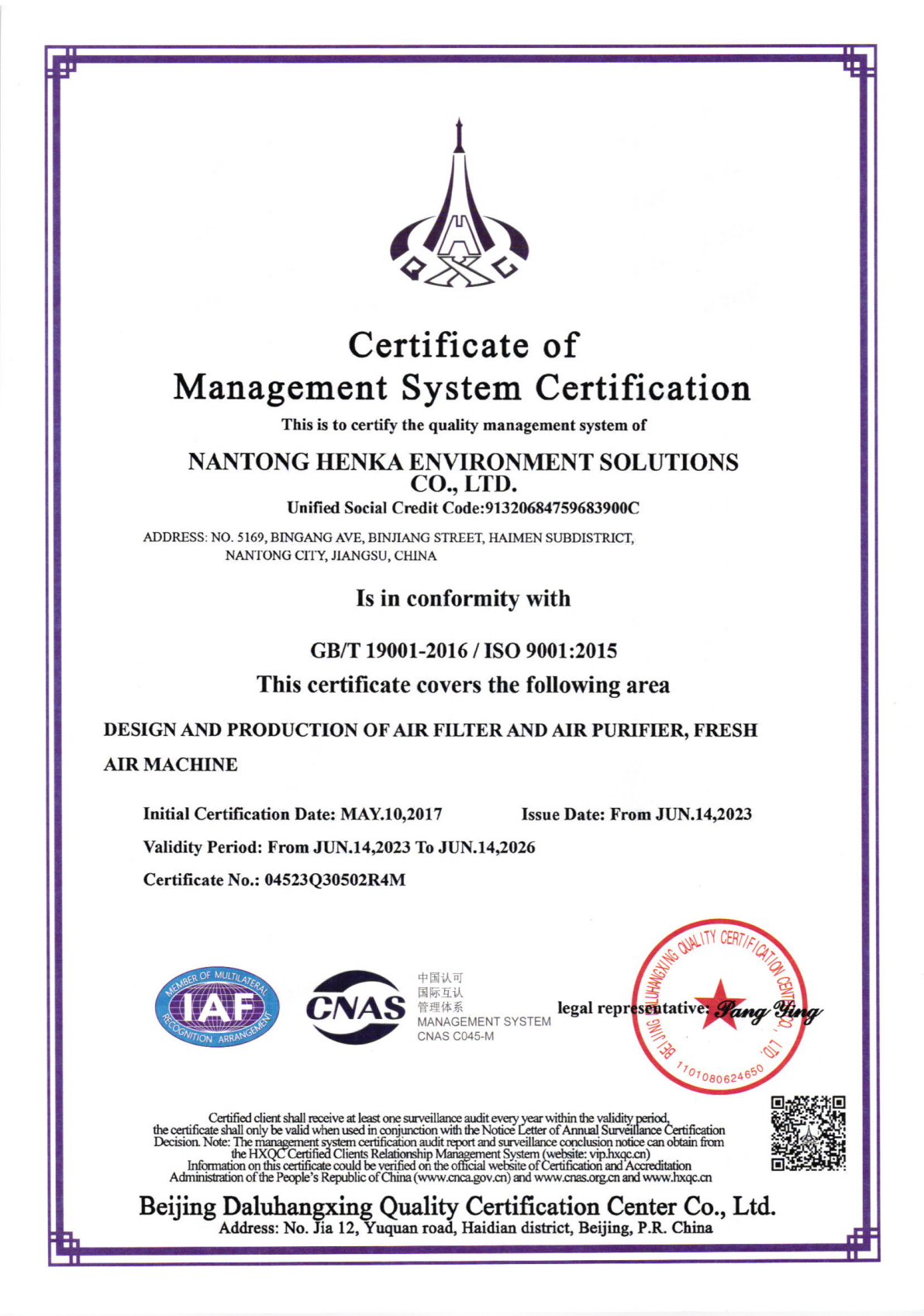
ISO9001:2015 and ISO14001:2015 certification covering the design and production of air filter, air purifier, and fresh air machine.
Frequently Asked Questions
1. Which framework defines the G1–G4 and F5–F9 grades, and is it still current?
The G and F grade letters come from EN 779, the framework that classified general ventilation filters into coarse and medium bands. EN 779:2012 has been completely replaced by ISO 16890 in Europe since mid-2018, so these grades now appear mainly in existing specifications, product ranges, and tender documents rather than as the current European reference. ASHRAE Standard 52.2 is a separate framework that classifies filters using MERV ratings from 1 to 16, and EN 1822 applies to a different band entirely — it classifies EPA, HEPA, and ULPA filters by filtration efficiency and zero leakage. When a project specification quotes a G or F grade, confirm which framework it is referenced against before comparing suppliers.
2. Can Henkaes manufacture both Panel Filters and Bag Filters, and customize them to project dimensions?
Yes. Both sit in the Henkaes HVAC Filtration range — Panel Filter at G1–G4 and Bag Filter at F5, F6, F8 and F9 — and both are produced for the commercial and public building sector, including airports, hotels, museums, and restaurants. Henkaes operates an OEM & ODM production model with customization available on size and logo, a monthly capacity of 200,000 pieces, and 100% inspection as the quality control standard. Because the same facility covers V-Bank, Furnace, Box, and Cleanroom filters, a pre-filter specification can be developed alongside the downstream stages it has to protect rather than in isolation.
3. What are the minimum order quantity and the main cost drivers for a pre-filter order?
The minimum order quantity for Henkaes pre-filter production is 500 pieces. Cost is driven by the efficiency grade selected, the frame dimensions, the filter material, and whether custom branding is required. The practical approach is to fix the grade and the face dimensions first, then compare structures — because a flat panel and a multi-pocket bag filter of the same nominal size represent different amounts of media and therefore different cost structures. Comparing quotations before the grade and dimensions are fixed produces numbers that cannot be compared meaningfully.
4. Can I request a physical sample before committing to volume production?
Sampling is part of the standard service scope. Henkaes designs products based on specifications, drawings, samples, or customer concepts, and provides complete engineering design services that include the production of engineering samples, production, and testing. The company's stated approach is to design and manufacture custom filters to solve specific filtration problems, using solid modeling and rapid prototyping. For a pre-filtration decision, a sample build is the point at which frame fit, gasket behavior, and real resistance in the actual air handling unit can be confirmed — variables that a specification sheet cannot resolve. Sample requests can be submitted through www.airfilterodm.com.
5. What is the standard lead time, and what support is available after delivery?
The standard lead time for Henkaes air filter production is 30 days. Orders involving custom dimensions or branding are scheduled after sample confirmation, since the design step precedes the production step. After-sales support is provided remotely. For buyers planning a two-stage pre-filtration installation across multiple air handling units, it is worth sequencing the order so that panel and bag filters are delivered together — a chain assembled in stages cannot be commissioned in stages.
Conclusion
Panel Filter and Bag Filter are not competing products. They are two positions in the same filtration chain, and the correct question is not which one wins but how far down the chain the building actually needs fine-particle removal to begin.
A Panel Filter at G1–G4 is the correct answer where the downstream stage already carries fine-particle duty, the particulate load is moderate, and the filter bank is accessible. It does the coarse-stage job at the lowest cost in the chain, and specifying beyond that adds resistance without improving the room.
A Bag Filter at F5–F9 is the correct answer where the fine-particle load is significant, where service access is restricted, or where a high-efficiency terminal stage needs a level of protection a flat panel cannot provide. The multi-pocket construction of microfine fiberglass gives it the media area to hold dust longer and keep resistance more stable — and that is what the additional cost buys.
Most commercial and public buildings are best served by using both: a G1–G4 panel as the first coarse stage, an F5–F9 bag filter as the medium stage behind it, and the high-efficiency stage downstream. Deciding the split between those two stages is the entire pre-filtration strategy, and it should be settled against the building's air quality requirement before a single unit is ordered.
Next step: confirm the grade and dimensions before comparing cost.
Send your face dimensions, required efficiency band, and downstream filter stage, and Henkaes can build a sample panel or bag filter for validation. Orders start from 500 pieces with a 30-day standard lead time.
Email: peter@airfilter-china.com | Tel: +86 138-1376-6750 | Web: www.airfilterodm.com
Download the full product range: E-Catalogue for Air Filter
Have Questions or Need More Details?
Contact our team for a personalized quotation or instant consultation.
Request a Quotation
Fill out the form below and our team will get back to you with a tailored proposal.
WhatsApp Direct Chat
Prefer to chat in real-time? Message us on WhatsApp for instant assistance & quick answers.
- Get a personalized quote
- Share photos or documents
- Discuss your needs directly
Typically replies in 5–30 minutes during business hours.