
How to Match Air Filters to Your Facility: An Application Guide by Industry Scenario
Matching an air filter to a facility begins with the environment, not the catalogue. The working sequence is short: identify the environment, match the efficiency grade, and then confirm material compatibility. Panel filters in G1–G4 grades and bag filters in F5–F9 grades serve commercial and public buildings. Box filters in MERV 15 and MERV 16 grades serve pharmaceutical plants, hospitals, and food and beverage production sites. Cleanroom air filters in U14/U15 grades serve microelectronics and data centers. V-bank filters in H13 grade serve airports, hotels, museums, and restaurants. The B737/B757 electronic cabin air filter (H13) serves aerospace cabin filtration, and HEPA, True HEPA, activated carbon and VOC removal filters serve household air purifiers and air cleaners.
This guide is organised as a decision sequence rather than a product list, because a filter specification is only as good as the facility facts behind it. Each section answers one question that a buyer, engineer or facility manager has to settle before a filter can be ordered: where will the filter be installed, what has to be captured, which grade band that environment requires, and which media and dimensions will actually survive the installation.
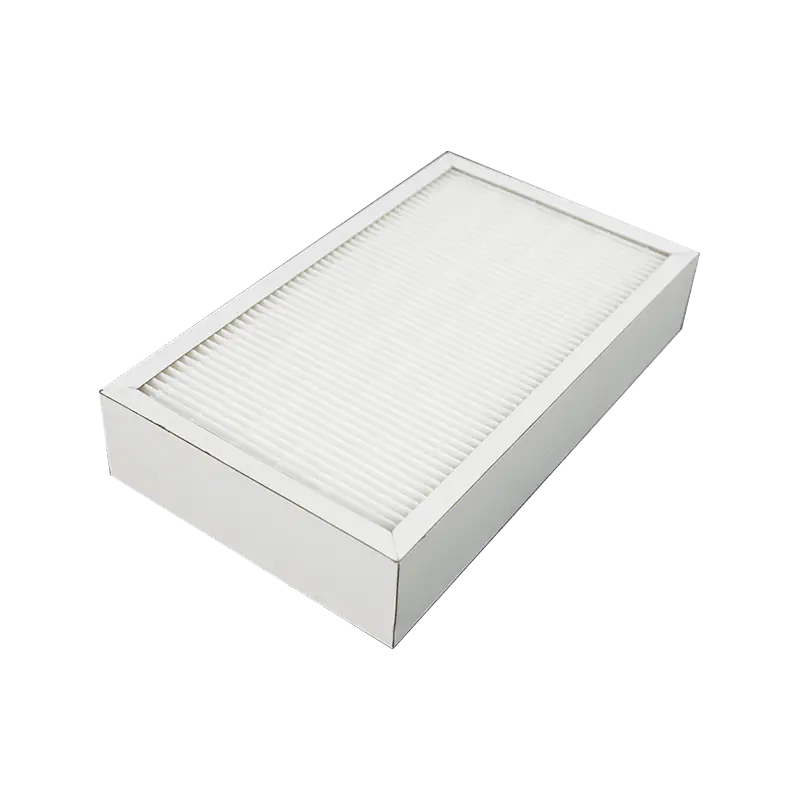
Problem Definition: Why Air Filter Matching Goes Wrong
Most filter complaints turn out to be specification problems rather than product problems, and they fall into three groups.
- Environment mismatch. A filter specified for normal indoor environment conditions behaves differently once the surrounding process changes. A pharmaceutical plant building, a food and beverage workshop renovation, a cleanroom design project and a commercial HVAC system are all matched to a fresh air system, but the particles they generate and the loading they place on the first stage are not the same. A household air purifier filter is matched to the purifier itself, and a B737/B757 electronic cabin air filter is built for aircraft working conditions rather than a building.
- Efficiency grade mismatch. A grade that is too low lets fine particles travel past the filter and load the components behind it. A grade that is too high is not free either: higher-efficiency media generally carry higher airflow resistance, which is why filter media efficiency and air resistance are measured and specified rather than assumed.
- Media and dimension mismatch. Fiberglass, Polypropylene (PP), microfine fiberglass, microfiberglass, PTFE, activated carbon and special catalyst media behave differently even within the same grade band. Customized dimensions are also listed as the special requirement across nearly every application scenario covered here, and a correct grade in the wrong frame simply does not install.
Industry Background: Standards, Market Context and Supplier Verification
Filter matching has become a larger procurement decision because the installed base keeps growing. The global air filters market was valued at USD 17.08 billion in 2025 and is projected to reach USD 34.66 billion by 2034 (Fortune Business Insights). HEPA filters held a 41.7% share of the air purifier technology segment in 2025 (Grand View Research), and the smart air purifier market is growing at a 14.1% CAGR from 2024 to 2030, driven by AI and IoT integration (Grand View Research).
Two standards carry most of the specification weight. ASHRAE 52.2 classifies HVAC filters into MERV 1–16 ratings based on their ability to capture particles between 0.3 and 10 micrometers, which is the reference framework behind MERV 8, MERV 11 and MERV 13 furnace air filters as well as MERV 15/16 box filters. EN 1822 classifies HEPA and ULPA filters by efficiency at the most penetrating particle size (MPPS), with H14 requiring 99.995% efficiency; the H13 and U14/U15 grades used in this guide sit inside that classification family. G1–G4 and F5–F9 grades come from the European coarse and fine filter classification system and routinely appear in the same building specification as MERV and EN 1822 values.
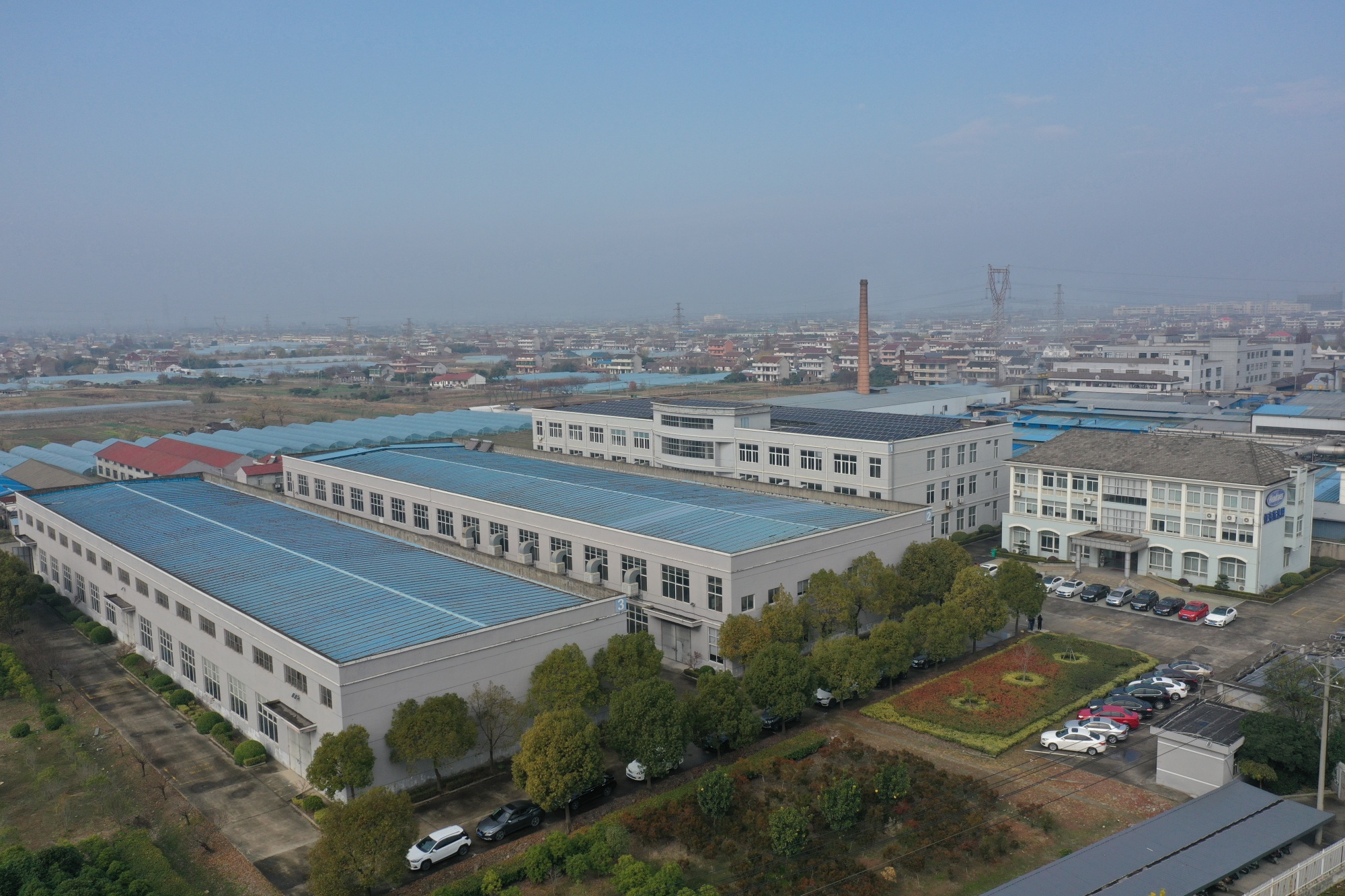
The manufacturer behind the models referenced in this guide is Nantong Henka Environment Solutions Co., Ltd, which trades as Henkaes. Founded in 2004 and based in Haimen District, Nantong City, Jiangsu Province, China, Henkaes produces HVAC, cleanroom, household and aerospace air filters, exports 69% of its output to the EU and USA, operates a 30,000 m² production base with an annual output of 2,000,000 pcs, and uses ASHRAE 52.2 in air filter testing. The company holds ISO 9001:2015, ISO 14001:2015 and ISO 45001:2018 certification and works with an R&D team of 11 engineers.
The Three-Step Matching Sequence
Step 1 — Identify the environment
Before looking at any grade table, record four facts about the space: what the space produces, which particles or gases have to be captured, which system the filter is mounted in, and what the installation interface allows. In the scenario data behind this guide, the matched equipment is a fresh air system for pharmaceutical plant buildings, food and beverage workshops, cleanroom projects, HVAC system buildings and the B737/B757 filter replacement application, while a household application is matched to an air purifier. That single distinction already separates two different filter families.
The capture task is equally specific. Most building and industrial scenarios are defined as capturing dust and fine particles. Household scenarios extend the list to pollen, VOC, bad smell, pet smell and special harmful gas, which is why carbon and catalyst stages appear in household filter stacks but not in the standard building stack.
Step 2 — Match the efficiency grade
Grade bands map to environments, not to preference. The mapping used in this guide is consistent across the product and scenario data:
- G1–G4 panel air filters and F5–F9 bag air filters — commercial and public buildings.
- MERV 8, MERV 11 and MERV 13 furnace air filters — commercial and public buildings, and residential furnace filter replacement.
- MERV 15 and MERV 16 box air filters — pharmaceutical plants, hospitals, and food and beverage production sites.
- H13 V-bank air filters — airports, hotels, museums, and restaurants.
- U14/U15 cleanroom air filters — data centers and microelectronics cleanrooms.
- H13 B737/B757 electronic cabin air filter — aerospace cabin and fresh-air systems.
- H13 HEPA and ≥99.97% True HEPA air filters — household air purifiers and air cleaners.
Step 3 — Confirm material compatibility
The media list that supports these grades is finite: fiberglass and Polypropylene (PP) for panel and V-bank constructions, microfine fiberglass for bag filters, microfiberglass for box and cleanroom filters and for the aerospace cabin filter, PTFE for cleanroom service, and activated carbon with special catalyst for VOC and odour control. Media selection follows the grade and the environment; it is not a cost shortcut. The remaining variable is the interface, and in the scenario data it is remarkably consistent — customized dimensions are the special requirement in pharmaceutical, food and beverage, cleanroom, HVAC, household and aerospace applications alike.
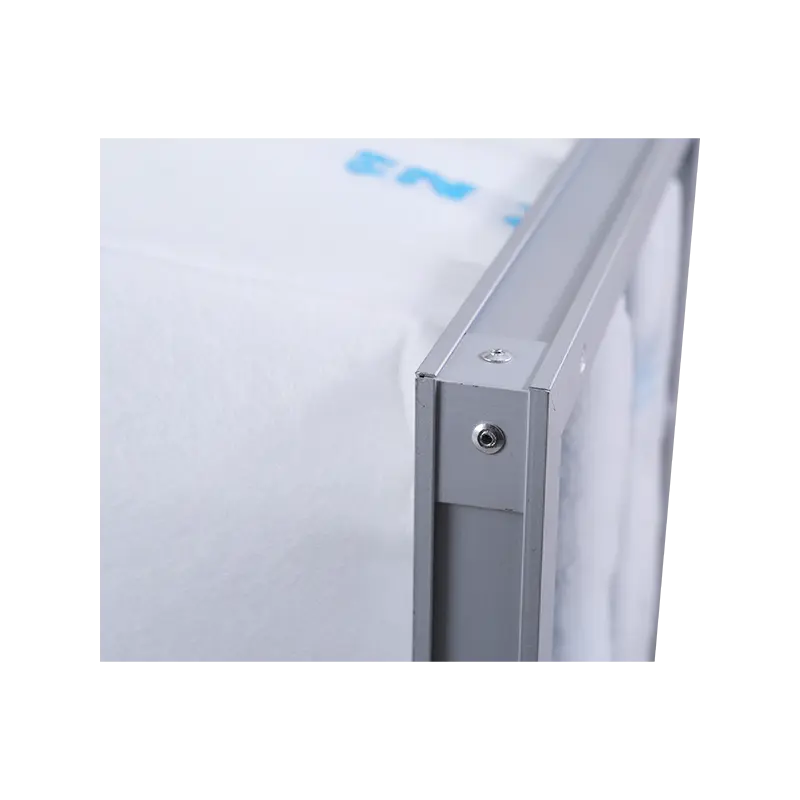
Filter Family by Facility Scenario
Commercial and public buildings: panel and bag filters
Panel air filters in G1–G4 grades, built with fiberglass or Polypropylene (PP), take the first filtration stage in airports, hotels, museums, restaurants and comparable public buildings. Bag air filters in F5, F6, F8 and F9 grades use microfine fiberglass and follow as the fine filtration stage in the same building types. Furnace air filters in MERV 8, MERV 11 and MERV 13 with PP media cover the same commercial and public building list and also map to residential furnace filter replacement. These three families are usually specified together as a staged system rather than as substitutes for one another.
Pharmaceutical plants, hospitals, and food and beverage production
Box air filters in MERV 15 and MERV 16 grades with microfiberglass media are specified for pharmaceutical plants, hospitals and food and beverage production sites. In pharmaceutical plant building projects the filter operates in automatic mode under normal indoor environment conditions, captures dust and fine particles, and works with a fresh air system. The same construction logic applies to workshop renovation in food and beverage plants, where normal indoor conditions and a fresh air system define the installation. The higher MERV band and the microfiberglass media are what distinguish this scenario from the panel and bag stages used elsewhere in the same building.
Microelectronics and data centers
Cleanroom air filters in U14/U15 grades use microfiberglass or PTFE media and are applied in cleanroom environments such as data centers and microelectronics production areas. In cleanroom design projects the filter operates automatically to capture dust and fine particles under normal indoor environment conditions. The higher grade band, the PTFE media option and the cleanroom interface together define this application — a MERV or H13 building filter is not a substitute here.
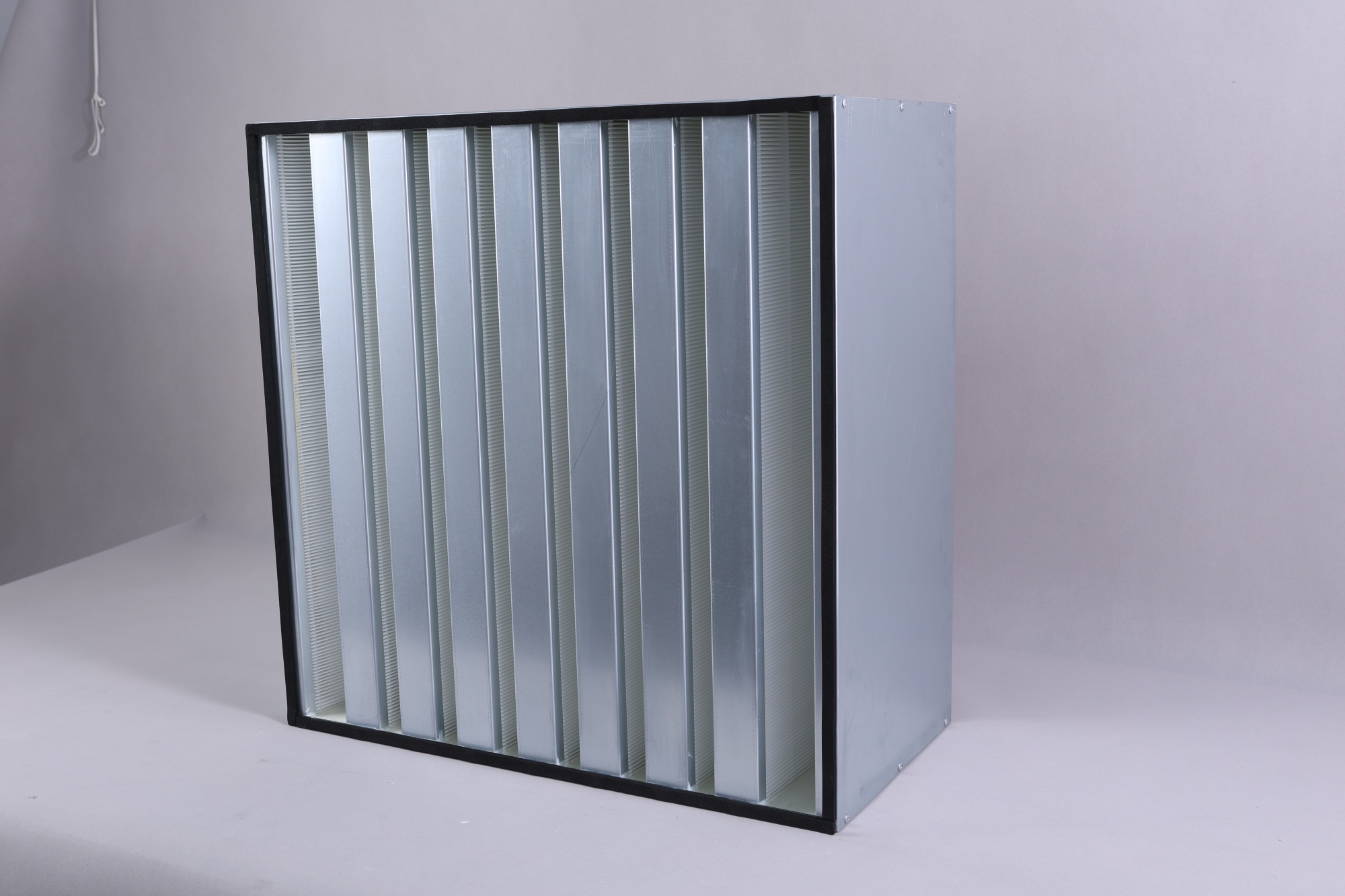
Airports, hotels, museums, and restaurants
V-bank air filters in H13 grade, available in fiberglass or Polypropylene (PP), are specified for airports, hotels, museums and restaurants. These are high-efficiency units installed inside commercial HVAC systems, and in practice they are the third element of a staged arrangement that begins with G1–G4 panel filters and continues through F5–F9 bag filters. Because the same building types appear in both the panel/bag list and the V-bank list, the grade sequence — not the facility name alone — is what separates the stages.
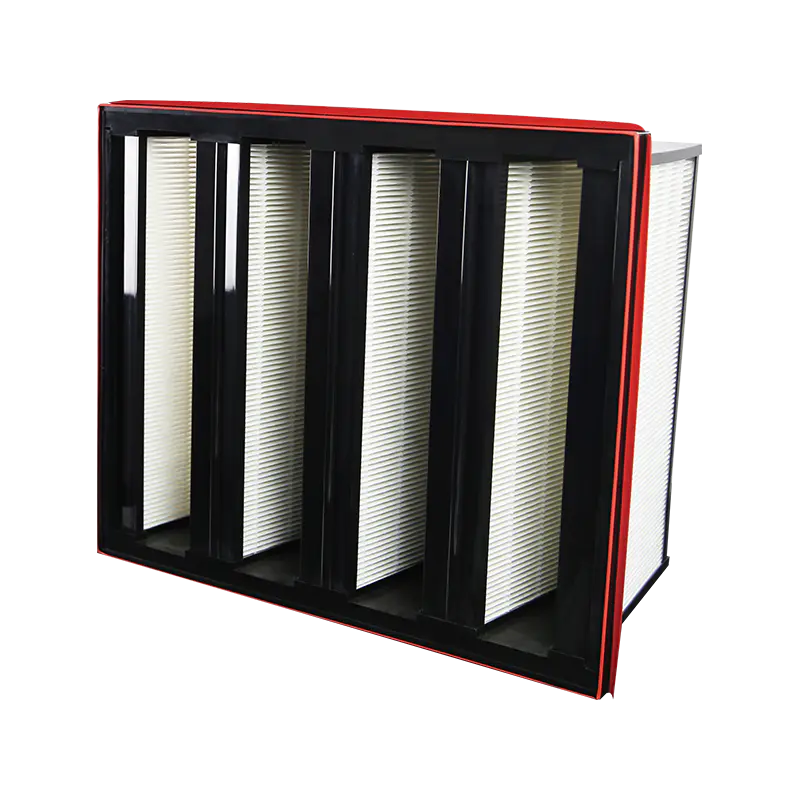
Aerospace: B737/B757 electronic cabin air filter
The B737/B757 electronic cabin air filter uses microfiberglass media at H13 grade and is engineered for B737/B757 aircraft working conditions. It operates in automatic mode, captures dust and fine particles, works with the fresh air system, and carries customized dimensions as its special requirement. The scenario it addresses is Boeing B737/B757 filter replacement, and the application data records it as typically applied in China. Because the operating condition is the aircraft itself rather than a building, this is the clearest example of why environment identification comes first in the matching sequence.
Household air purifiers and air cleaners
Four household filter families cover the different indoor-air problems an air purifier has to solve. HEPA air filters at H13 grade and True HEPA air filters rated at ≥99.97% use fiberglass or PP media to capture dust, fine particles and pollen. Activated carbon air filters graded CTC70, CTC80, CTC90 and CTC100 address odour and bad smell. VOC air filters combine activated carbon with a special catalyst to remove VOC, pet smell and special harmful gas. All four operate in automatic mode under normal indoor environment conditions, are matched to the air purifier itself, and — as with the building filters — carry customized dimensions as the special requirement.
Step-by-Step: Matching a Filter to Your Facility
- Define the space and its process. State the facility type (commercial or public building, pharmaceutical plant, hospital, food and beverage plant, cleanroom, aircraft, household room), the environment (normal indoor environment conditions or aircraft working conditions), and the equipment the filter sits in (fresh air system or air purifier).
- Set the capture target. Dust and fine particles for most building and industrial scenarios; add pollen, VOC, bad smell, pet smell or special harmful gas for household purifier applications.
- Pick the grade band from the environment. G1–G4 → F5–F9 → MERV 8/11/13 for commercial and public buildings; MERV 15/16 for pharmaceutical, hospital and food and beverage production; H13 V-bank for airports, hotels, museums and restaurants; U14/U15 for cleanrooms; H13 cabin grade for aerospace; H13 or ≥99.97% HEPA plus carbon and catalyst stages for household purifiers.
- Choose the construction. Panel, bag, box, V-bank, cleanroom, electronic cabin or purifier filter — the construction follows the airflow path and the mounting interface, not the grade alone.
- Confirm media compatibility. Match fiberglass, Polypropylene (PP), microfine fiberglass, microfiberglass, PTFE, activated carbon, or activated carbon with special catalyst to the grade band and to the particles or gases present.
- Lock the dimensions and validate. Confirm customized dimensions against the actual installation, then validate the specification through engineering sample production and 100% inspection before full production begins.
Application Scenarios in Practice
The scenario data used for this guide repeats the same structure for every industry: industry, working condition, function, matched equipment and special requirement. The table below shows how consistently the interface and the special requirement resolve once the environment is identified.
| Application scenario | Working condition | Matched equipment | Special requirement |
|---|---|---|---|
| Pharmaceutical plant building | Normal indoor environment | Fresh air system | Customized dimensions |
| Food and beverage workshop renovation | Normal indoor environment | Fresh air system | Customized dimensions |
| Cleanroom design (microelectronics, data centers) | Normal indoor environment | Fresh air system | Customized dimensions |
| HVAC system building | Normal indoor environment | Fresh air system | Customized dimensions |
| Residential furnace filter replacement | Normal indoor environment | Fresh air system | Customized dimensions |
| Household air purifier | Normal indoor environment | Air purifier | Customized dimensions |
| Boeing B737/B757 filter replacement | B737/B757 aircraft working conditions | Fresh air system | Customized dimensions |
Production evidence supports the same scenario logic. A US air filter ODM customer ordered 50,000 PCS of filters for formaldehyde removal and reported stable performance over 2 years. A second US ODM project of 50,000 PCS for purifier air in indoor environments ran stable for 1 year with good VOC removal performance. A US OEM project of 20,000 PCS for indoor purifier air also ran stable for 1 year, with high efficiency as the recorded highlight.
Comparison Table: Models, Grades, Media and Matched Facilities
The table below consolidates the filter models, efficiency grades, media and matched facility scenarios for the Henkaes air filter range. It is intended as a matching reference, not as a ranking — the correct choice always depends on the environment identified in Step 1.
| Model | Efficiency grade | Media | Facility / application scenario |
|---|---|---|---|
| Panel Filter | G1–G4 | Fiberglass, Polypropylene (PP) | Commercial and public buildings: airports, hotels, museums, restaurants |
| Bag Filter | F5, F6, F8, F9 | Microfine fiberglass | Commercial and public buildings |
| Furnace Air Filter | MERV 8, MERV 11, MERV 13 | Polypropylene (PP) | Commercial and public buildings; residential furnace filter replacement |
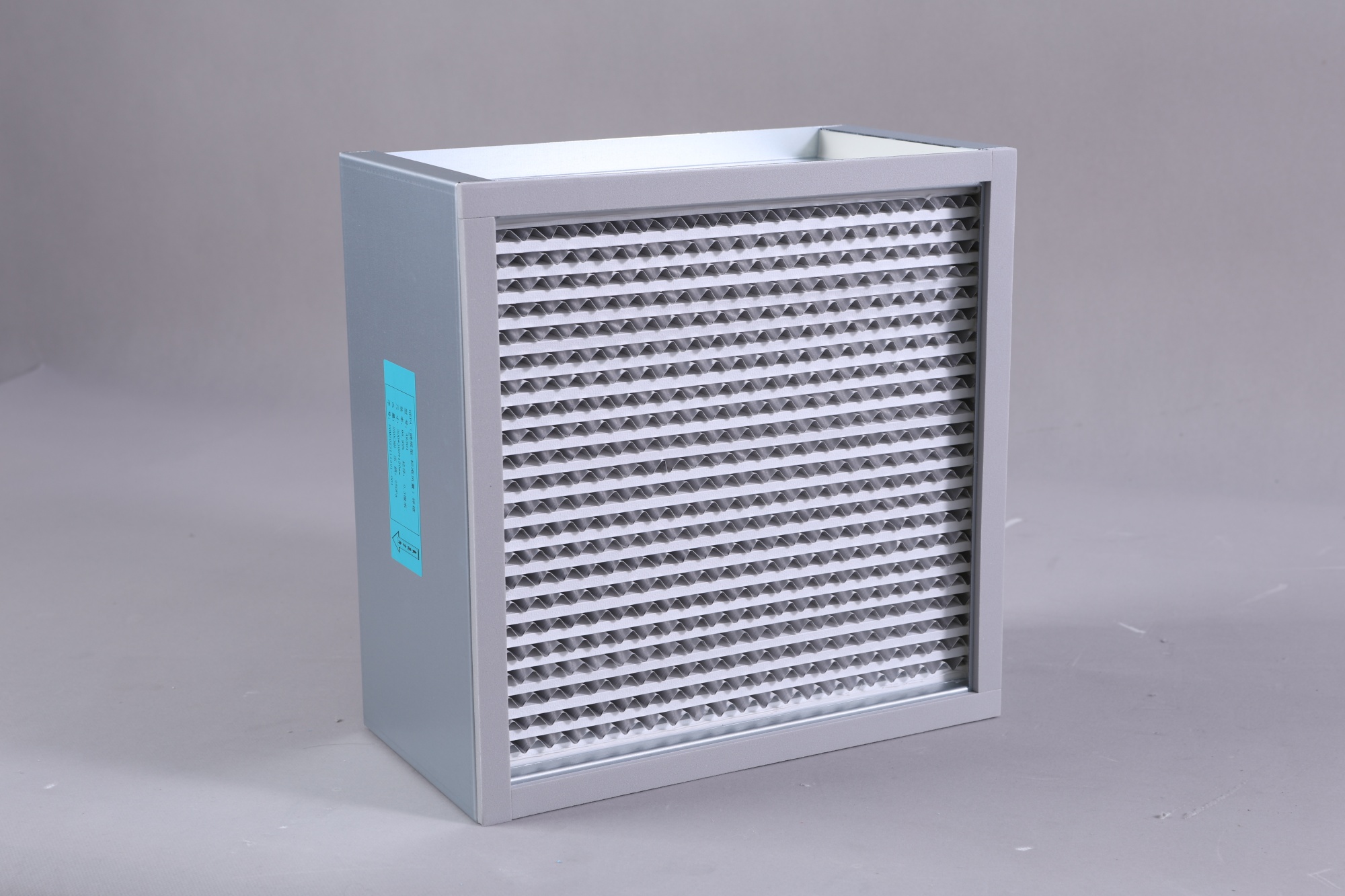
| Box Filter | MERV 15, MERV 16 | Microfiberglass | Pharmaceutical plants, hospitals, food and beverage production sites |
| V-Bank Filter | H13 | Fiberglass, Polypropylene (PP) | Commercial and public buildings: airports, hotels, museums, restaurants |
| Cleanroom Air Filter | U14/U15 | Microfiberglass, PTFE | Cleanrooms: data centers, microelectronics |
| B737/B757 Electronic Cabin Air Filter | H13 | Microfiberglass | Aerospace and aviation: B737/B757 cabin filter replacement |
| HEPA Air Filter | H13 | Fiberglass, Polypropylene (PP) | Household air purifiers and air cleaners |
| True HEPA Air Filter | ≥99.97% | Fiberglass, Polypropylene (PP) | Household air purifiers and air cleaners |
| Activated Carbon Filter | CTC70, CTC80, CTC90, CTC100 | Activated carbon | Household air purifiers: odour and bad smell control |
| VOC Air Filter | Special catalyst: removes special VOC | Activated carbon and special catalyst | Household air purifiers: VOC, pet smell, special harmful gas |
FAQ: Matching Air Filters to a Facility
Which standards should I check when matching an air filter to a facility?
Use ASHRAE 52.2 for HVAC filters: it classifies filters into MERV 1–16 ratings based on their ability to capture particles between 0.3 and 10 micrometers, which covers the MERV 8, MERV 11 and MERV 13 furnace grades and the MERV 15/16 box grades. Use EN 1822 for high-efficiency filters: it classifies HEPA and ULPA filters by efficiency at the most penetrating particle size (MPPS), with H14 requiring 99.995% efficiency, and the H13 V-bank, H13 cabin and U14/U15 cleanroom grades sit within that family. On the supplier side, verify ISO 9001:2015, ISO 14001:2015 and ISO 45001:2018 certification and confirm that ASHRAE 52.2 is genuinely used in the supplier's air filter testing.
Can air filters be customized to my facility's dimensions and logo?
Yes. Customized dimensions are the special requirement listed for pharmaceutical, food and beverage, cleanroom, HVAC, household and aerospace scenarios, and Henkaes produces on an OEM and ODM basis with size and logo customization. The engineering design service covers filter specifications, engineering sample production, production and testing, and works from specifications, drawings, samples or a customer idea. It is supported by 11 engineers and more than 20 years of experience working with a US engineering team.
What should I budget for a facility air filter programme?
Budget planning follows the specification, because grade band, media and customization all change the filter that has to be produced. The practical variables are order quantity against a minimum order quantity of 500 PCS, the customization scope against the standard size and logo options, the media selected (fiberglass, Polypropylene, microfine fiberglass, microfiberglass, PTFE, activated carbon, or activated carbon with special catalyst), and the production lead time of 30 days. Monthly capacity is 200,000 PCS, so volume should be confirmed before the specification is frozen.
Can I validate a filter before committing to full production?
Yes. Engineering sample production is part of the supplier's engineering design service, and every unit passes 100% inspection. Validation is supported by an efficiency and air resistance test system for filter media, a noise test lab, a 30 m³ test room for formaldehyde and VOC removal efficiency, and a CADR test room for air purifiers, with ASHRAE 52.2 used in air filter testing. Production records follow the same approach: a US ODM customer ordered 50,000 PCS of air filters for formaldehyde removal and reported stable performance over 2 years, and a second US ODM project of 50,000 PCS for VOC removal in indoor purifier air ran stable for 1 year.
What is the lead time and production capacity?
Lead time is 30 days, the minimum order quantity is 500 PCS, and monthly capacity is 200,000 PCS. Annual output is 2,000,000 pcs from a 30,000 m² facility, 69% of output is exported to the EU and USA, and after-sales support is provided remotely. To start matching filters to your own facility, share the facility type, environment, capture target and required dimensions with the Henkaes team — the air filter catalogue linked at the end of this guide is the fastest starting point.
Conclusion: Environment First, Grade Second, Media Third
The matching logic is repeatable. Commercial and public buildings resolve to G1–G4 panel filters and F5–F9 bag filters, with MERV 8/11/13 furnace filters where the same buildings or residential furnaces are involved. Pharmaceutical plants, hospitals and food and beverage production sites resolve to MERV 15/16 box filters with microfiberglass media. Microelectronics and data centers resolve to U14/U15 cleanroom filters with microfiberglass or PTFE media. Airports, hotels, museums and restaurants resolve to H13 V-bank filters. Aerospace resolves to the H13 B737/B757 electronic cabin air filter, and household air purifiers resolve to H13 HEPA, ≥99.97% True HEPA, activated carbon and VOC removal filters.
Because customized dimensions are the recurring requirement across every one of these scenarios, the specification conversation is faster when the facility facts are settled first. Confirm the environment, the capture target and the interface, then confirm the grade and media that the environment demands — in that order, the filter choice becomes a consequence of the facility rather than a guess about it.
Need a filter matched to your facility?
Send the facility type, working environment, capture target and required dimensions. Henkaes (Nantong Henka Environment Solutions Co., Ltd) manufactures OEM and ODM air filters with a 30-day lead time and a 500 PCS minimum order quantity.
Download the Air Filter E-Catalogue · Visit www.airfilterodm.com · Email peter@airfilter-china.com · Tel +86 138-1376-6750 · Chat on WhatsApp
Contact: Peter Zhou
Have Questions or Need More Details?
Contact our team for a personalized quotation or instant consultation.
Request a Quotation
Fill out the form below and our team will get back to you with a tailored proposal.
WhatsApp Direct Chat
Prefer to chat in real-time? Message us on WhatsApp for instant assistance & quick answers.
- Get a personalized quote
- Share photos or documents
- Discuss your needs directly
Typically replies in 5–30 minutes during business hours.