
Smart Manufacturing Air Filter FAQs: Solving Cleanroom, HVAC, and Process Contamination Scenarios
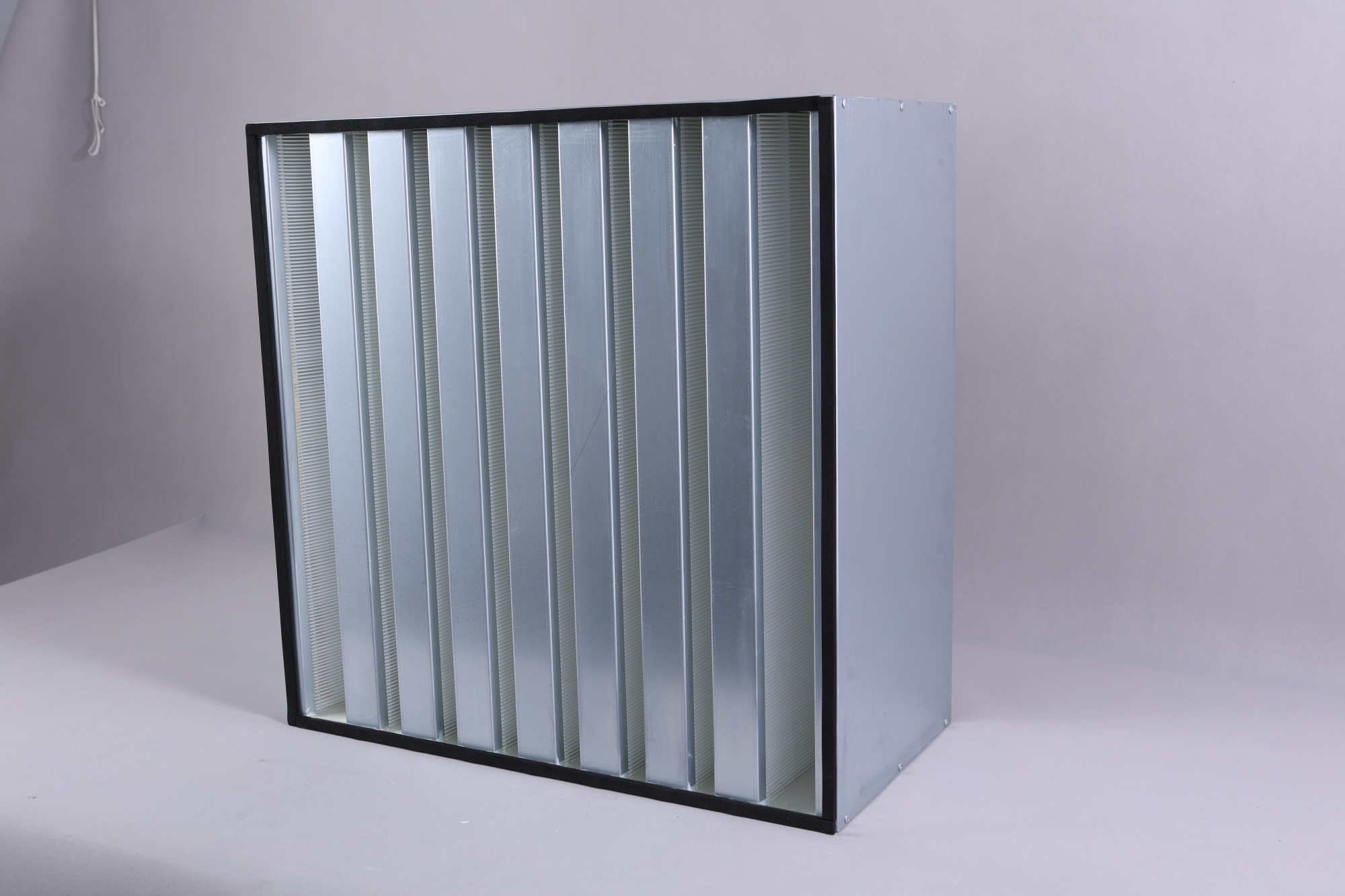
Cleanroom Air Filter (U14/U15), microfiberglass and PTFE, documented for data centers and microelectronics cleanrooms.
A smart manufacturing site rarely runs one air quality regime. A microelectronics cleanroom, a pharmaceutical suite, a food production hall and the HVAC serving offices, corridors and public areas can sit inside the same campus and fail in completely different ways when filtration is specified loosely. The question buyers actually ask is not which filter is best in general, but which filter belongs to which scenario, and what evidence should exist before a purchase order is signed.
Short answer: in a smart manufacturing facility, filter selection follows the contamination source and the capture grade required at the point of use, not the building type. Four product families cover most recurring scenarios: Cleanroom Air Filter (U14/U15) for microelectronics and data centers; Box Filter (MERV 15 and MERV 16) for pharmaceutical plants, hospitals and food and beverage production sites; V-Bank Filter (H13) for commercial and public building HVAC; and Bag Filter (F5, F6, F8 and F9) for general HVAC in commercial and public buildings.
Henkaes is the brand of Nantong Henka Environment Solutions Co., Ltd., an air filter manufacturer established in 2004 in Haimen City, Jiangsu Province, China, about 120 km from Shanghai, manufacturing filters for air purifiers, air cleaners and ventilation systems. This article is written for buyers, facility engineers and sourcing teams in the awareness and research phase. Every grade, material and application statement below is taken from Henkaes published product specifications or from publicly documented standards. Where a figure is not published, it is not stated here.
Problem Definition: What Fails When Filtration Is Under-Specified
Most filtration failures in a smart manufacturing plant are not filter failures. They are specification failures, where a filter met its stated grade but was applied to a contamination problem it was never selected for. Three patterns repeat across cleanroom, process and building HVAC zones.
1. Particle carryover into a controlled zone
In microelectronics and data center environments, the failure mode is carryover: contamination that should have been removed upstream reaches the product or the equipment. Henkaes Cleanroom Air Filter is classified in the cleanroom industry category at efficiency grade U14/U15, is built from microfiberglass and PTFE, and is documented for data centers and microelectronics. The grade answers the capture question. The media and the frame answer the service-life and resistance questions that follow.
2. Process-to-process cross contamination
In pharmaceutical plants, hospitals and food and beverage production sites, the risk is not only particle count inside a single room. It is the movement of particulate and biological material between zones that carry different cleanliness requirements. Henkaes Box Filter, rated MERV 15 and MERV 16 with microfiberglass media, is specified for exactly those three environments. Air is handled through a fresh air system under normal indoor conditions, and customized dimensions appear as a standard requirement rather than an exception.
3. HVAC-side load, energy and maintenance
The third problem is economic. General HVAC in commercial and public buildings carries the largest air volume at the lowest contamination level, and airports, hotels, museums and restaurants are the documented applications across the Henkaes HVAC range. Specifying a high-efficiency filter in every position raises the resistance the fan has to overcome and shortens service intervals. That is why lower-grade products such as the Bag Filter at F5, F6, F8 and F9 and the Panel Filter at G1 to G4 exist alongside higher grades in the same building.
The practical conclusion is that one grade cannot cover a site. A cascade of a coarse stage, an intermediate stage and a final stage is what allows each zone to be served at the grade it actually needs.
Industry Background: Three Standards You Meet Before You Compare Grades
Filter grades are only comparable inside the framework that produced them. Three frameworks appear in smart manufacturing specifications, and mixing them is the most common source of quotation mismatch.
- ASHRAE 52.2 and MERV. ASHRAE Standard 52.2 classifies filters using MERV ratings from 1 to 16. MERV is derived from the performance efficiency calculated from synthetic-dust loading tests. In the Henkaes range, MERV values appear on the Box Filter (MERV 15 and MERV 16) and on the Furnace Air Filter (MERV 8, MERV 11 and MERV 13).
- EN 1822. In Europe, EPA, HEPA and ULPA filters are classified according to EN 1822 for filtration efficiency and zero leakage. The Henkaes Cleanroom Air Filter (U14/U15), the V-Bank Filter (H13) and the B737/B757 Electronic Cabin Air Filter (H13) sit in this family.
- EN 779 and its replacement. EN 779:2012 was completely replaced in Europe by ISO 16890 from mid-2018, while ASHRAE 52.2 remains the framework behind MERV values. The F-class designations on the Bag Filter (F5 to F9) and the G-class designations on the Panel Filter (G1 to G4) originate in the EN 779 family.
Two practical rules follow. First, a specification should name the framework, not only the class letter or number, so that the supplier test report and the buyer acceptance criteria refer to the same method. Second, when a European project still uses F or G classes, the buyer should state whether acceptance follows the legacy class designation or an ISO 16890 report, because the two are not interchangeable without a mapping.
Testing capability matters as much as the grade. Henkaes holds ISO 14001:2015, ISO 9001:2015 and ISO 45001:2018 certifications, uses ASHRAE 52.2 for air filter testing, and operates an efficiency and air resistance test system for filter media, a noise test lab, a 30 m³ test room for formaldehyde and VOC removal efficiency, and a CADR test room for air purifiers.
Detailed Solution: Mapping Each Scenario to a Filter Family
Each of the four core scenarios below is described by the grade, the media and the application that Henkaes publishes for that product, followed by the specification question a buyer should resolve before ordering.
Cleanroom Air Filter U14/U15 for microelectronics and data centers
The Cleanroom Air Filter is classified in the cleanroom industry category at efficiency grade U14/U15 and is manufactured from microfiberglass and PTFE. Documented applications are data centers and microelectronics. In cleanroom design projects the filter operates in automatic mode under normal indoor conditions, captures dust and fine particles, and works with a fresh air system as supporting equipment. Customized dimensions are a documented special requirement, and this application pattern is common in the United States and the Netherlands.
Specification question: which EN 1822 grade does the room classification actually require, and what leakage acceptance test will be applied at commissioning? U14 and U15 are different ratings, and the difference should be a documented decision rather than a default.
Box Filter MERV 15 and MERV 16 for pharmaceutical, hospital and food production zones
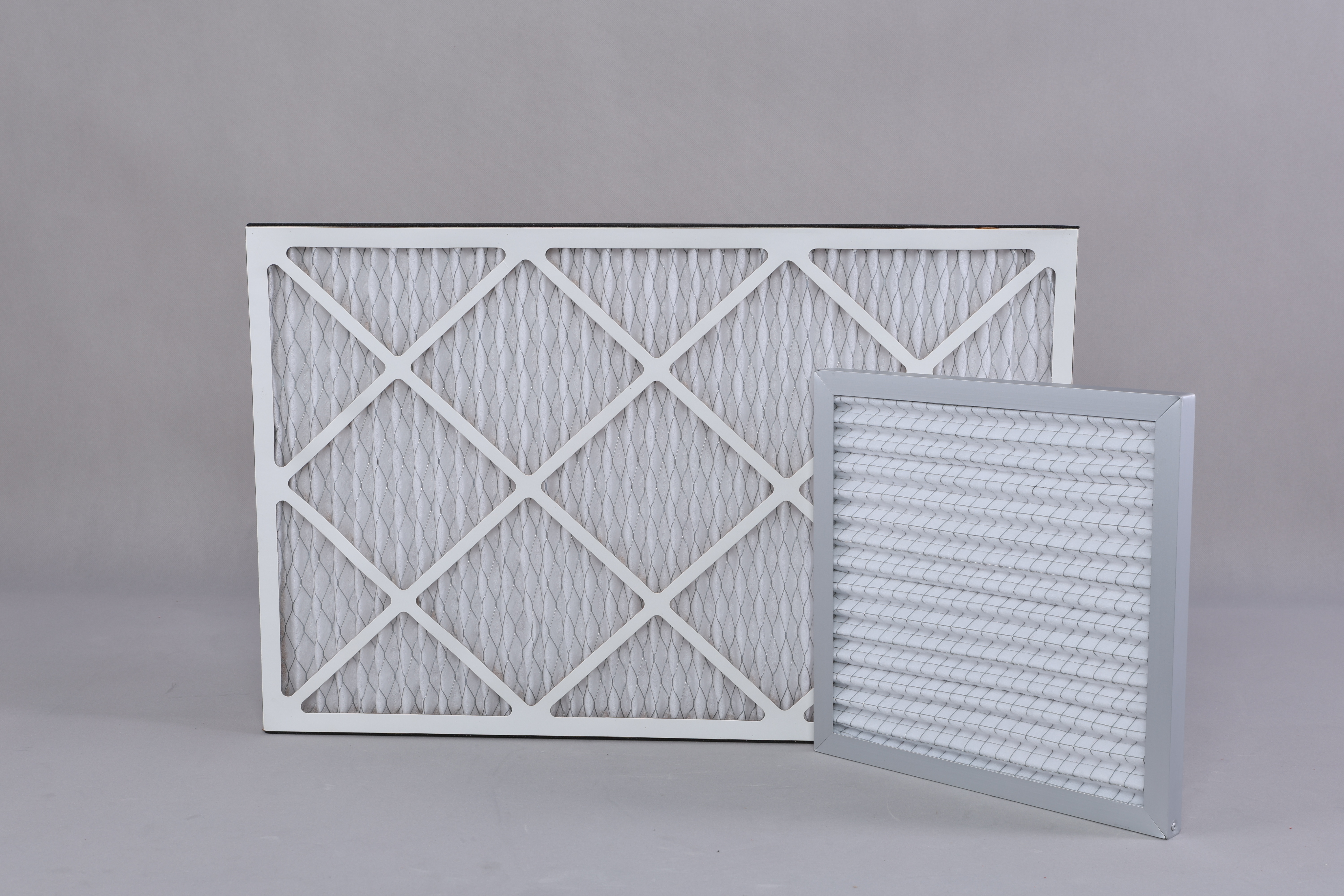
Box Filter, microfiberglass media, MERV 15 and MERV 16 — specified for pharmaceutical plants, hospitals and food and beverage production sites.
The Box Filter is an HVAC filtration product made of microfiberglass with efficiency ratings of MERV 15 and MERV 16. It is intended for pharmaceutical plants, hospitals and food and beverage production sites. In pharmaceutical plants building projects it captures dust and fine particles under normal indoor conditions in automatic mode with a fresh air system, and customized dimensions are again a documented requirement. The same application pattern is common in the United States and the Netherlands, and the product is also referenced for Chinese pharmaceutical and food production projects.
Specification question: is MERV 15 sufficient, or does the zone require MERV 16? The two ratings sit next to each other in the product line but carry different test outcomes, and the choice should be tied to the room classification rather than to price or availability.
V-Bank Filter H13 for commercial and public building HVAC
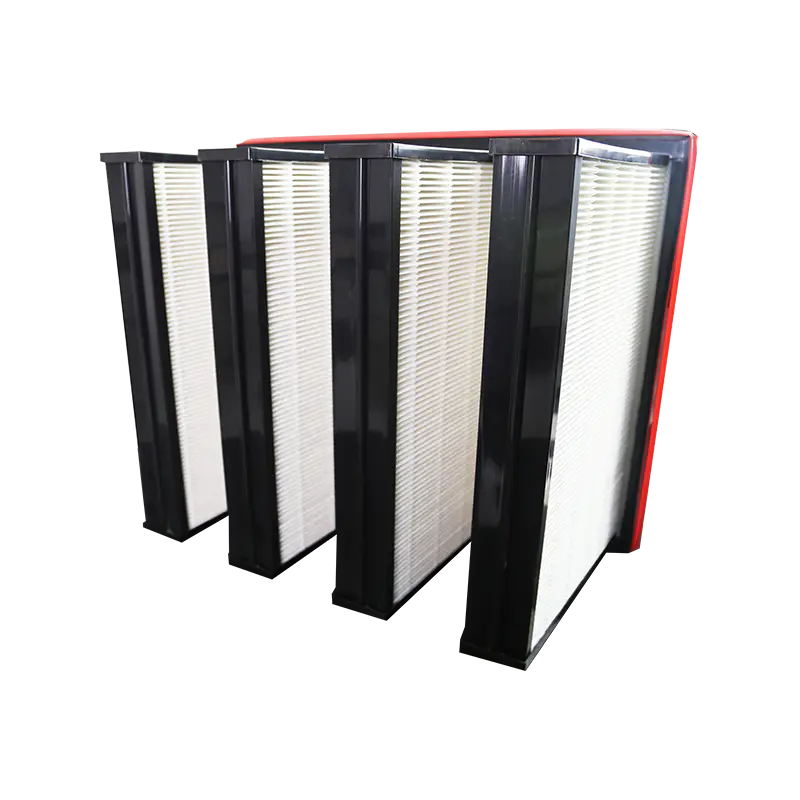
V-Bank Filter, fiberglass and polypropylene, H13 — for airports, hotels, museums and restaurants.
The V-Bank Filter is an HVAC filtration product with efficiency grade H13, manufactured from fiberglass and polypropylene. Documented applications are commercial and public buildings, typically airports, hotels, museums and restaurants. The V-bank format places a larger media area into a given face dimension than a flat panel, which is why it is used where a higher grade is required inside a standard HVAC frame without rebuilding the air handling unit. Combined with a coarse upstream stage, it allows a public building to reach a high-efficiency final stage while keeping the fan duty within the design envelope.
Specification question: where in the AHU train does the H13 stage sit, and what pre-filter protects it? A high-efficiency final stage without adequate upstream protection will load faster than the maintenance plan assumes.
Bag Filter F5 to F9 for general HVAC
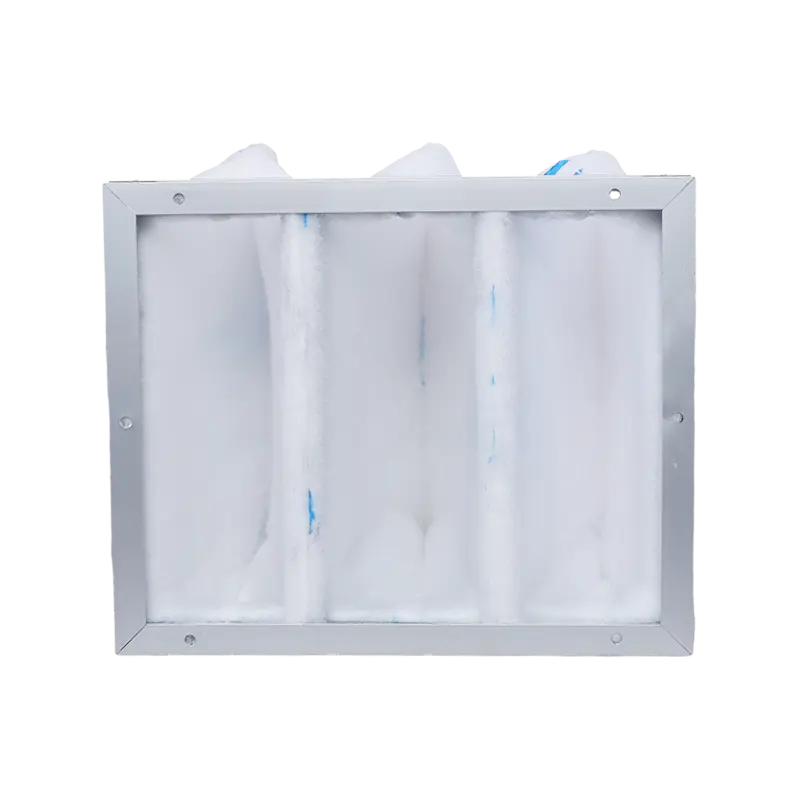
Bag Filter, microfine fiberglass, F5, F6, F8 and F9 — general HVAC for commercial and public buildings.
The Bag Filter is made of microfine fiberglass and is available in efficiency grades F5, F6, F8 and F9. It is intended for commercial and public buildings, with airports, hotels, museums and restaurants as the documented applications. The pocket construction holds a large media surface in a compact frame, which is the reason this format is used as the intermediate stage in a cascade serving large air volumes. Because the grades span F5 to F9, one product family can cover several positions in the same building at different protection levels.
Specification question: which F grade applies to which position, and is the acceptance basis the legacy EN 779 class or an ISO 16890 report? This is the single most frequent source of mismatch in European HVAC tenders.
Pre-filtration: Panel Filter G1 to G4 and Furnace Air Filter MERV 8 to MERV 13
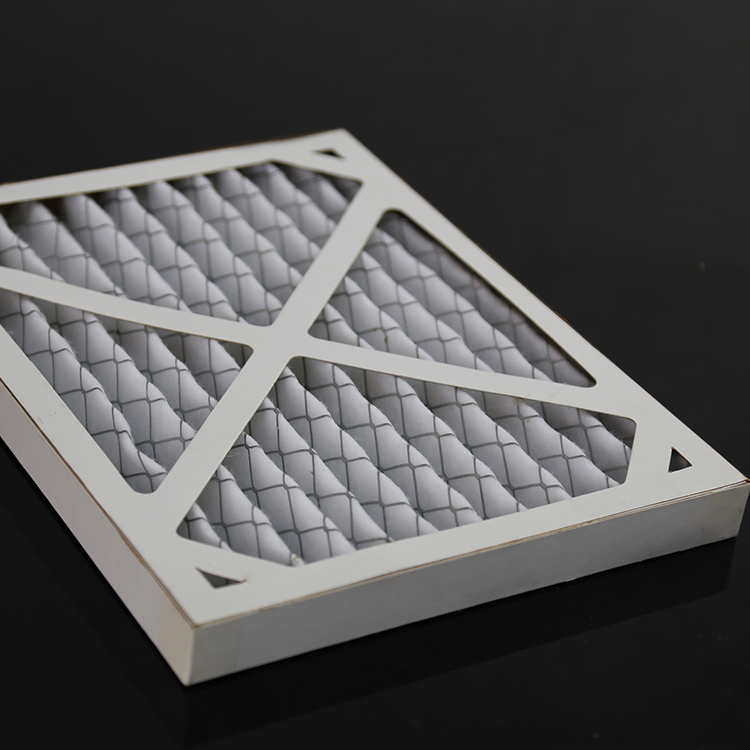
Furnace Air Filter, polypropylene media, MERV 8, MERV 11 and MERV 13 — commercial and public building HVAC pre-filtration.
Two lower-grade families complete the picture. The Panel Filter, made of fiberglass and polypropylene with efficiency range G1 to G4, is intended for commercial building ventilation in commercial and public buildings. The Furnace Air Filter, made of polypropylene with MERV 8, MERV 11 and MERV 13, is intended for the same building types, including airports, hotels, museums and restaurants. Both are used upstream of a higher-grade final stage, and both are also used on their own where the zone has no elevated cleanliness requirement.
Step-by-Step Breakdown: A Six-Step Specification Sequence
The sequence below converts a contamination scenario into a purchasable specification. It works for a new cleanroom, a pharmaceutical renovation and an HVAC retrofit alike.
Step 1 — Characterize the zone and the contaminant
Record what has to be captured (dust, fine particles, biological material, VOCs) and where it must be captured. A microelectronics cleanroom, a pharmaceutical suite and a hotel lobby are three different problems even when all three are described internally as air quality issues.
Step 2 — Choose the standard framework before the grade
Decide whether the zone is governed by EN 1822 (EPA, HEPA, ULPA classes such as H13, U14 and U15), by ASHRAE 52.2 and MERV (1 to 16), or by a legacy EN 779 class that has to be mapped to ISO 16890. Naming the framework first prevents a quotation that answers a different question.
Step 3 — Build the cascade, not the single filter
Place a coarse stage first, an intermediate stage second and the final stage last. A Panel Filter at G1 to G4 or a Furnace Air Filter at MERV 8 to MERV 13 can carry the upstream load, while a Bag Filter at F5 to F9, a Box Filter at MERV 15 or MERV 16, or a V-Bank Filter at H13 carries the final duty. Each stage then has a defined role in the maintenance plan.
Step 4 — Match the media to the duty
Microfiberglass and PTFE appear on the Cleanroom Air Filter, microfiberglass on the Box Filter, microfine fiberglass on the Bag Filter, fiberglass and polypropylene on the V-Bank and Panel Filters, and polypropylene on the Furnace Air Filter. Media selection should follow the documented product specification for the grade in question instead of being treated as an interchangeable detail.
Step 5 — Fix the test method and the documentation
State which test standard the supplier must report against. Henkaes uses ASHRAE 52.2 for air filter testing and maintains an efficiency and air resistance test system for filter media, a noise test lab, a 30 m³ formaldehyde and VOC removal test room and a CADR test room for air purifiers, alongside ISO 14001:2015, ISO 9001:2015 and ISO 45001:2018 certifications.
Step 6 — Freeze the dimensions and validate before the batch
Customized dimensions appear as a documented special requirement across the cleanroom, pharmaceutical, food and beverage and HVAC scenarios described in this article. Freeze the dimensional drawing early, then confirm fit and grade with an engineering sample before committing to production volume.
Use Cases: Four Scenarios in Practice
Microelectronics cleanroom on a smart factory campus
A U14/U15 Cleanroom Air Filter stage protects the lithography and inspection areas, with a Panel Filter stage upstream to hold back coarse dust. Dimensions are customized to the ceiling grid, and the EN 1822 grade is tied to the room classification rather than to a generic efficiency target.
Data hall inside the same campus
Data centers are also a documented application for the Cleanroom Air Filter at U14/U15. The selection logic differs from the fabrication area: the objective is protecting equipment from fine particle accumulation while keeping the air handling train serviceable.
Pharmaceutical plant or hospital block
A Box Filter at MERV 15 or MERV 16 carries the final stage in pharmaceutical plants building projects and hospital areas, with a Furnace Air Filter or Panel Filter stage upstream. The MERV value is chosen against the zone requirement, and the fresh air system configuration is confirmed at design stage.
Food and beverage production hall
Food and beverage production sites are listed alongside pharmaceutical plants and hospitals for the Box Filter. Workshop renovation projects follow the same logic: capture dust and fine particles, keep the final stage protected, and confirm customized dimensions against the existing duct layout.
Airport, hotel, museum or restaurant HVAC
Public and commercial buildings combine a Bag Filter at F5 to F9 or a Furnace Air Filter at MERV 8 to MERV 13 with a V-Bank Filter at H13 where the design requires a high-efficiency final stage inside a standard frame.
Comparison Table: Air Filter Types by Grade, Media and Application
| Filter family | Documented efficiency grade | Media | Documented application | Standard family |
|---|---|---|---|---|
| Cleanroom Air Filter | U14/U15 | Microfiberglass, PTFE | Cleanroom industry: data centers, microelectronics | EN 1822 |
| Box Filter | MERV 15, MERV 16 | Microfiberglass | Pharmaceutical plants, hospitals, food and beverage production sites | ASHRAE 52.2 (MERV) |
| V-Bank Filter | H13 | Fiberglass, polypropylene | Airports, hotels, museums, restaurants | EN 1822 |
| Bag Filter | F5, F6, F8, F9 | Microfine fiberglass | Commercial and public buildings: airports, hotels, museums, restaurants | EN 779 class family |
| Panel Filter | G1 to G4 | Fiberglass, polypropylene | Commercial building ventilation: airports, hotels, museums, restaurants | EN 779 class family |
| Furnace Air Filter | MERV 8, MERV 11, MERV 13 | Polypropylene | Airports, hotels, museums, restaurants | ASHRAE 52.2 (MERV) |
Note on framework status: EN 779:2012 was replaced in Europe by ISO 16890 from mid-2018, while ASHRAE 52.2 remains the framework behind MERV. A specification that quotes an F or G class for a European project should state which framework governs acceptance.
Frequently Asked Questions
Which standard should a cleanroom air filter be specified against: MERV, EN 779 or EN 1822?
For a cleanroom filter rated U14/U15, the relevant framework is EN 1822, which is used in Europe to classify EPA, HEPA and ULPA filters by filtration efficiency and zero leakage. MERV comes from ASHRAE 52.2, which classifies filters on a 1 to 16 scale and applies to the Box Filter at MERV 15 and MERV 16 and the Furnace Air Filter at MERV 8, MERV 11 and MERV 13. EN 779 is the legacy general ventilation framework that was replaced in Europe by ISO 16890 from mid-2018. A cleanroom specification that quotes MERV for a U14/U15 filter is mixing two frameworks and should be rewritten before quotation.
What efficiency grades and media can Henkaes supply across cleanroom and HVAC filtration?
Six families cover the documented range. Cleanroom Air Filter: U14/U15 in microfiberglass and PTFE. Box Filter: MERV 15 and MERV 16 in microfiberglass. V-Bank Filter: H13 in fiberglass and polypropylene. Bag Filter: F5, F6, F8 and F9 in microfine fiberglass. Panel Filter: G1 to G4 in fiberglass and polypropylene. Furnace Air Filter: MERV 8, MERV 11 and MERV 13 in polypropylene. The household and aerospace lines add HEPA filters at H13, True HEPA filters at 99.97 percent and above, activated carbon filters at CTC70 to CTC100, VOC removal filters with activated carbon and a special catalyst, and the B737/B757 Electronic Cabin Air Filter at H13 per EN 1822. Customized dimensions are a documented requirement across the cleanroom, pharmaceutical, food and beverage and HVAC scenarios, and the company provides OEM and ODM support covering design, sample making, production and testing.
What should an RFQ contain so that filter quotations are comparable?
Include six items: the standard framework and class or MERV value; the exact dimensions and any customization required; the media where the application fixes it; the zone or industry the filter serves; the documentation and acceptance expectations, including the test method; and the annual and first-order quantity. Cost position is driven by grade, media, format and customization depth, so two quotes for different grades or media are not comparable even when the dimensions match. No verified public price list exists for these products, which means an itemized quotation, not a published figure, is the correct basis for budget comparison.
Can dimensions and media be validated before mass production?
Yes. Customized dimensions are a documented special requirement in cleanroom design projects, pharmaceutical plants building projects, food and beverage workshop projects and HVAC system projects, so the dimensional drawing is part of the specification rather than an afterthought. Henkaes provides complete engineering design services including engineering sample production, production and testing, solid modeling and rapid prototyping, and works from specifications, drawings or samples. Validating fit and grade in the actual housing before the batch is the lowest-cost way to avoid a commissioning problem.
What is the standard lead time, and how does a buyer start a specification review?
Henkaes published company information cites an annual production capacity of 2,000,000 pieces and a 30-day standard lead time, with approximately 69 percent of output exported to Europe and the USA. Lead time should always be confirmed against the specific grade, customization depth and order volume, because a customized U14/U15 cleanroom filter and a standard Bag Filter do not follow the same production route. To start, send the zone description, the framework and grade, the dimensions and the annual volume; the next step is a quotation against that specification.
Conclusion
Cleanroom contamination, process cross contamination and HVAC load are three separate problems, and a smart manufacturing site needs three separate answers. The mapping is consistent: Cleanroom Air Filter at U14/U15 in microfiberglass and PTFE for microelectronics and data centers; Box Filter at MERV 15 or MERV 16 in microfiberglass for pharmaceutical plants, hospitals and food and beverage production sites; V-Bank Filter at H13 in fiberglass and polypropylene for airports, hotels, museums and restaurants; Bag Filter at F5 to F9 in microfine fiberglass for general HVAC; and Panel Filter at G1 to G4 or Furnace Air Filter at MERV 8 to MERV 13 as the upstream stage that protects all of them. The decisive step is not choosing the highest grade available, but naming the standard framework and the acceptance test before the grade is fixed.
Next Step: Match a Filter to Your Scenario
Share your zone description, required framework and grade, dimensions and annual volume, and the Henkaes team will respond with a specification-based quotation. The full product range, grades and media are listed in the downloadable catalogue.

Henkaes manufacturing facility, Haimen City, Jiangsu Province — 30,000 m² with an annual capacity of 2,000,000 pieces.
Download the catalogue: E-Catalogue for Air Filter
Email: peter@airfilter-china.com | Tel: +86 138-1376-6750 | Website: www.airfilterodm.com
Address: No 5169, Bin'gang Ave, Binjiang Subdistrict, Haimen District, Nantong City, Jiangsu Province, China 226113.
Have Questions or Need More Details?
Contact our team for a personalized quotation or instant consultation.
Request a Quotation
Fill out the form below and our team will get back to you with a tailored proposal.
WhatsApp Direct Chat
Prefer to chat in real-time? Message us on WhatsApp for instant assistance & quick answers.
- Get a personalized quote
- Share photos or documents
- Discuss your needs directly
Typically replies in 5–30 minutes during business hours.