
V-Bank vs. Bag vs. Panel Filters: A Comparison Guide for Commercial HVAC Buyers
Panel, bag, and V-Bank filters are not three versions of the same purchase. They are three stages of one filtration chain. Panel filters (G1–G4, fiberglass or polypropylene) perform first-stage protection in commercial and public buildings. Bag filters (F5–F9, microfine fiberglass) perform the intermediate stage in the same building types. V-Bank filters (H13, fiberglass or polypropylene) perform the high-efficiency final stage in demanding spaces such as airports, hotels, museums, and restaurants. The practical answer for most commercial HVAC buyers is therefore not “which one” but “which combination, in which order, against which declared standard.”
This guide gives procurement teams a side-by-side framework for that decision: what each filter family is built to do, how their efficiency bands differ, how the standards behind those bands differ, and how to sequence them in a building specification without over-specifying or under-protecting the system.
Problem Definition: Why Filter Comparisons Go Wrong
Most commercial HVAC filter mistakes are not caused by buying a poor product. They are caused by comparing three products that were never designed to compete on the same axis. Three errors repeat in tender documents and RFQs.
- Comparing efficiency classes across different standards. A G4 class, an F7 class, and an H13 class do not come from the same classification framework, so a direct numeric comparison between them is misleading unless the framework is stated on both sides of the comparison.
- Treating each filter as a standalone purchase. A V-Bank filter placed in a system with no effective upstream stage carries the full dust load of the building, while a panel filter used as the only filtration stage cannot deliver high-efficiency final filtration regardless of how often it is changed.
- Choosing on unit price alone. The cheapest filter in a chain is usually the panel filter, and it is also the one replaced most often. Judging the purchase on per-piece price hides the interaction between stages, which is what actually governs replacement frequency across the chain.
A workable comparison therefore has to answer three questions at once: what efficiency band does the space require, which stage of the chain does the filter occupy, and which standard is the class expressed in.
Industry Background: The Standards Behind the Classes
The efficiency classes used for panel, bag, and V-Bank filters come from frameworks that were developed for different purposes and at different times. Buyers do not need to master the standards, but they do need to know which framework a quoted class belongs to, because that determines whether two numbers can be compared at all.
ASHRAE 52.2 and the MERV scale
ASHRAE Standard 52.2 classifies filters using MERV ratings from 1 to 16, and MERV is based on the performance efficiency calculated from synthetic-dust loading tests. In practice, a MERV figure describes general ventilation filter performance under that test method, and it is the reference most often encountered in North American specifications.
The G and F classes, and the EN 779 to ISO 16890 transition
The G1–G4 and F5–F9 classes used for panel and bag filters belong to the coarse and fine filter class family that European procurement has used for decades. That framework has changed: EN 779:2012 was completely replaced in Europe by ISO 16890 from mid-2018, while ASHRAE 52.2 remains the classification framework behind MERV values. The consequence for buyers is practical rather than academic — legacy G and F classes still appear in older specifications, in supplier catalogues, and in markets outside Europe, so a 2026 tender should state which framework the quoted class is expressed in and whether an ISO 16890 equivalent is available.
EN 1822 and the H-class family
In Europe, EN 1822 is the standard used to classify EPA, HEPA, and ULPA filters by filtration efficiency and zero leakage. The H13 class specified for high-efficiency V-Bank filters sits inside this high-efficiency family, which is why V-Bank specifications are typically written in EN 1822 terms rather than in G/F terms. It is also why a V-Bank H13 filter and a bag F9 filter should never be presented as adjacent options on a single scale.
Detailed Solution: What Each Filter Family Is Built For
Panel Filter (G1–G4, fiberglass or polypropylene)
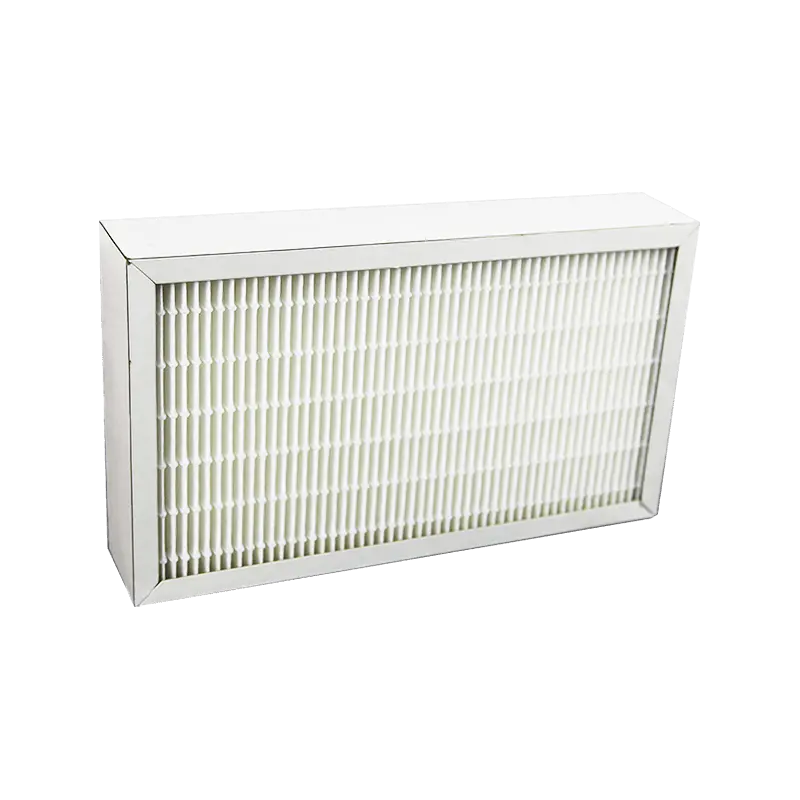
A panel filter is the first-stage component of a commercial filtration chain. It is specified in the G1–G4 band, uses fiberglass or polypropylene media, and is installed in commercial and public buildings where the objective is to protect downstream filters and the air-handling equipment itself. Its design intent is coarse protection, not final air quality.
The limit matters as much as the capability: a G1–G4 panel filter is not designed to deliver high-efficiency final filtration. When a space requires H13-level final filtration, the panel filter supports that requirement by protecting the stage that delivers it — it does not replace it.
Bag Filter (F5–F9, microfine fiberglass)
A bag filter occupies the intermediate stage. It is specified in the F5–F9 band, uses microfine fiberglass media, and is applied in commercial and public buildings as the second stage behind a panel filter. The bag format is the standard choice when a project needs a defined step up in efficiency between coarse pre-filtration and a high-efficiency final stage.
Its boundary is the efficiency band itself. An F5–F9 bag filter is a fine filter, not a high-efficiency final filter; where a specification calls for H13, a bag filter cannot be substituted on class grounds, only complemented.
V-Bank Filter (H13, fiberglass or polypropylene)
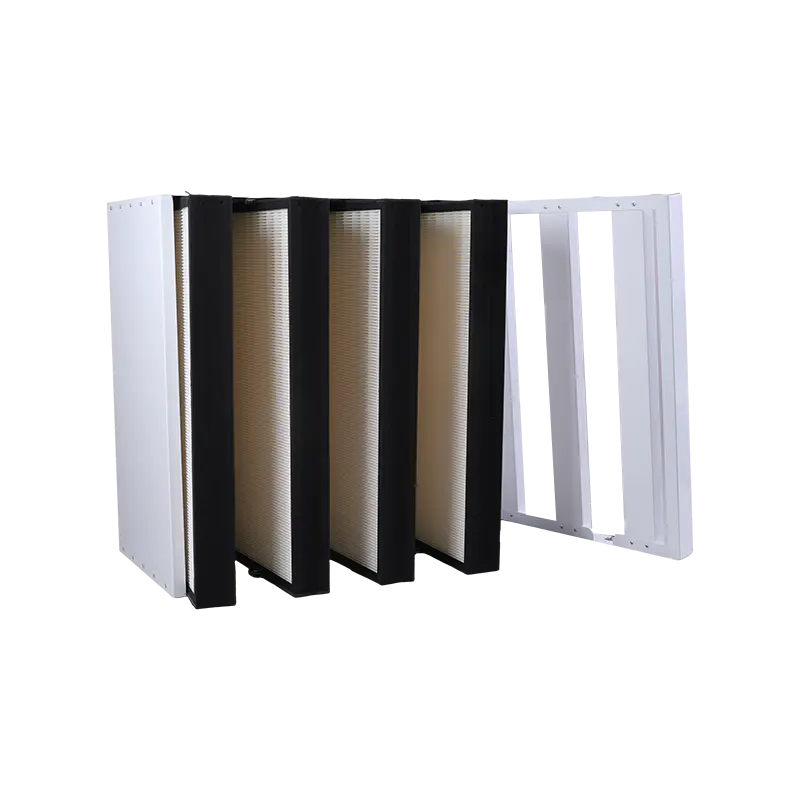
A V-Bank filter is the high-efficiency final stage. It is specified at H13, uses fiberglass or polypropylene media, and is applied in airports, hotels, museums, and restaurants — spaces where the filtration target is high-efficiency final filtration rather than coarse protection. The V-Bank format places several media packs in a V-arrangement inside a single frame, which is why face dimensions, depth, and holding-frame compatibility have to be confirmed with the supplier before the specification is frozen.
The constraint is upstream dependency. A high-efficiency final stage performs its role only when the panel and bag stages ahead of it are correctly specified and maintained; a V-Bank filter is not a substitute for pre-filtration, and skipping the earlier stages moves the entire dust load onto the most expensive element in the chain.
Side-by-Side Comparison Table
| Comparison dimension | Panel Filter | Bag Filter | V-Bank Filter |
|---|---|---|---|
| Efficiency class band | G1–G4 | F5–F9 | H13 |
| Classification framework | Coarse class family (legacy EN 779 G-classes; Europe migrated to ISO 16890 from mid-2018) | Fine class family (legacy EN 779 F-classes; same ISO 16890 migration) | High-efficiency family classified under EN 1822 for EPA/HEPA/ULPA |
| Media / material | Fiberglass or polypropylene | Microfine fiberglass | Fiberglass or polypropylene |
| Position in the filtration chain | First stage / coarse protection | Intermediate stage | High-efficiency final stage |
| Typical building fit | Commercial and public buildings | Commercial and public buildings | Airports, hotels, museums, restaurants |
| Main function | Protect downstream filters and air-handling equipment | Raise efficiency between pre-filtration and the final stage | Deliver high-efficiency final filtration to the served space |
| Known limitation | Not a high-efficiency final stage on its own | Efficiency band stops below H13 | Depends on effective upstream stages; depth and frame compatibility must be confirmed |
| What to verify before ordering | Declared class plus the framework and test reference on the datasheet | Declared class plus media specification and test reference | Declared H13 class, EN 1822 reference, and dimensional fit |
The table compares design intent and declared class position only. Class numbers from different frameworks are not interchangeable without a supplier-provided mapping; ASHRAE 52.2 MERV values (1–16) and EN 1822 high-efficiency classes describe different test scopes and should not be placed on a single scale.
Step-by-Step Breakdown: A Six-Step Selection Process
The following sequence is designed for procurement teams evaluating a commercial HVAC filtration package, not a single filter SKU. It can be applied building by building or zone by zone.
Step 1 — Define the required final efficiency for each space
Start from the space, not the product. Airports, hotels, museums, and restaurants are the application types that typically call for a high-efficiency final stage, which in this comparison means an H13 V-Bank filter. General commercial and public building zones usually sit at the coarse and fine bands served by panel and bag filters. Writing the space requirement first prevents a filter type from being chosen for the wrong room.
Step 2 — Map the filtration chain and the stage positions
Once the final efficiency is defined, assign the upstream stages. A zone requiring H13 final filtration normally needs a panel first stage and a bag intermediate stage ahead of the V-Bank element; a zone requiring only coarse or fine filtration normally needs the panel and bag stages alone. This is the step where most over- and under-specification is avoided.
Step 3 — Confirm the physical constraints
Confirm face dimensions, available depth, and holding-frame compatibility for each stage before the specification is frozen. V-Bank construction in particular places several media packs inside one frame, so depth and frame fit should be verified against the actual air-handling unit rather than assumed from a catalogue class.
Step 4 — Check the declared standard on the datasheet
Require the datasheet to state the class, the framework the class is expressed in, and the test reference behind it. A G4 statement without a framework reference, or an H13 statement without an EN 1822 reference, is an incomplete specification regardless of how the filter performs in service.
Step 5 — Compare on lifecycle, not on unit price
Evaluate the package as a system: which stage will be replaced most often, how the upstream stages reduce load on the downstream ones, and what the total replacement volume looks like over a service period. A slightly stronger first stage that protects the V-Bank element can change the economics of the whole chain more than a per-piece discount on the panel filter.
Step 6 — Validate with samples before committing volume
Request physical samples of each stage and confirm dimensions, media, framing, and labeling against the specification. Sampling is also the point at which OEM/ODM capability, minimum order quantity, and production lead time should be confirmed in writing.
Use Cases: Matching the Three Filter Types to Building Types
The application split below follows the design intent of each filter family and is intended as a starting framework rather than a fixed rule; each project should still be confirmed against its own ventilation design.
- Airports. High-efficiency final filtration is the reason V-Bank H13 filters are specified, with panel and bag stages protecting them upstream in the same air-handling chain.
- Hotels. Guest areas and public interiors are the typical V-Bank H13 application, while the back-of-house and general ventilation zones can be served by the bag and panel stages alone.
- Museums. A V-Bank H13 final stage is the appropriate specification where high-efficiency final filtration is the design target, again behind adequate pre-filtration.
- Restaurants. V-Bank H13 serves the high-efficiency final stage requirement in these spaces, with the panel and bag stages carrying the coarse and fine load ahead of it.
- Commercial and public buildings. Panel filters in G1–G4 and bag filters in F5–F9 are the standard pairing: the panel filter protects the system, the bag filter raises efficiency between pre-filtration and any high-efficiency stage.
- Mixed-use and multi-zone buildings. The most common real-world configuration is a single building running all three: panel first stage across the whole system, bag filters on the zones with a fine filtration requirement, and V-Bank H13 elements only on the zones whose design calls for high-efficiency final filtration.
Supplier Capability: What to Verify Beyond the Class Number
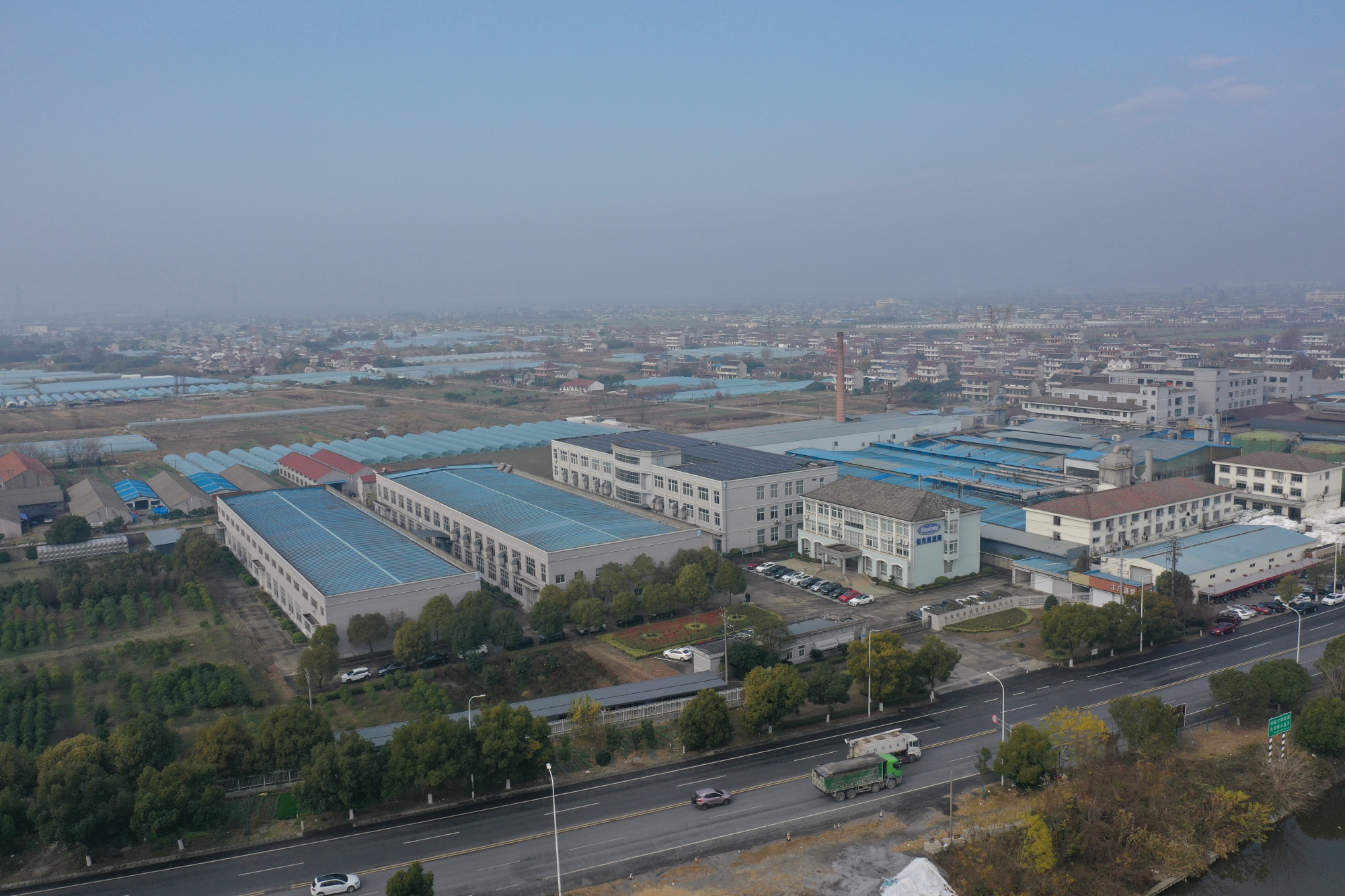
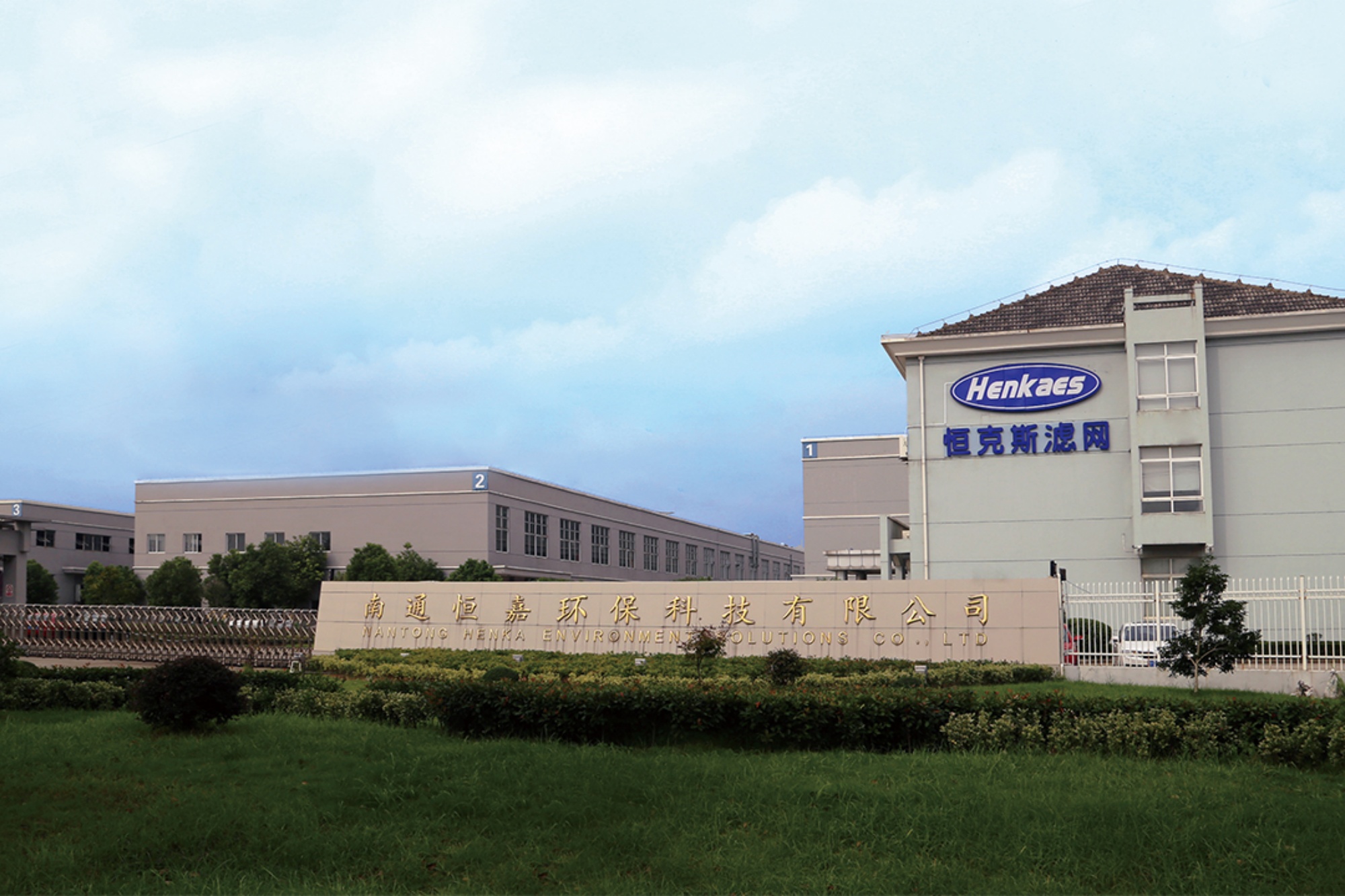
Henkaes (Nantong Henka Environment Solutions Co., Ltd) is an air filter manufacturer based in Haimen District, Nantong City, Jiangsu Province, China, founded in 2004, producing HEPA, HVAC, activated carbon, VOC removal, and customized air filters for air purifiers, air cleaners, and ventilation systems. The company manufactures across the filter types compared in this guide, including V-Bank Filter, Bag Filter, Panel Filter, Box Filter, and Cleanroom Air Filter models, which means a three-stage specification can be sourced as one qualification process rather than three.
Reported company facts relevant to a commercial HVAC evaluation:
- Founded in 2004; 30,000 m² facility; 63 employees; 11 engineers; annual output of 2,000,000 pcs; 69% of output exported to the EU and USA.
- Monthly capacity of 200,000 PCS with a standard lead time of 30 days and a minimum order quantity of 500 PCS.
- OEM & ODM production with size and logo customization, 100% inspection, and remote after-sales support.
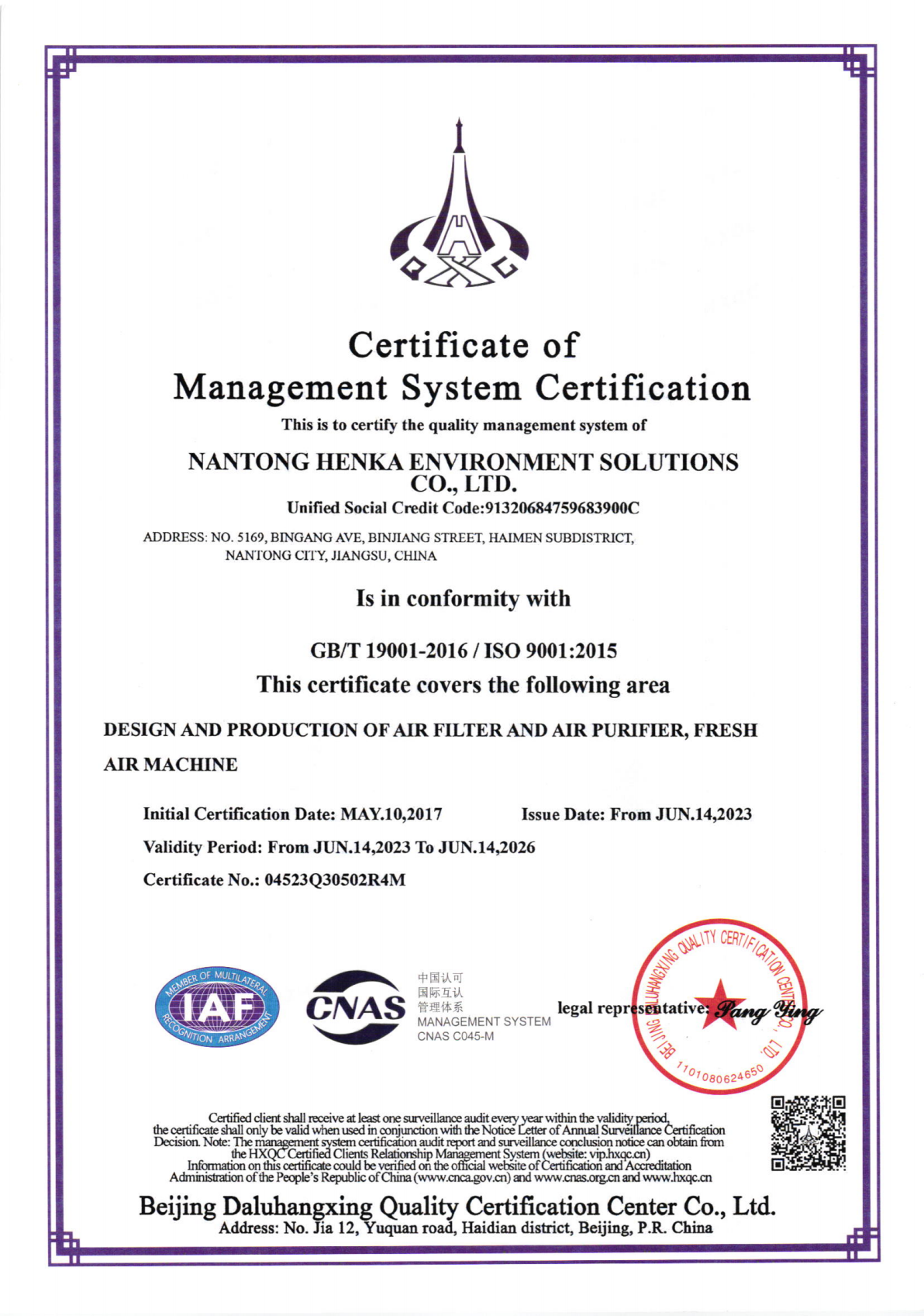
- ISO 9001:2015, ISO 14001:2015, and ISO 45001:2018 certifications reported for the scope of design and production of air filters, air purifiers, and fresh air machines; ASHRAE 52.2 is used in filter testing, and the company references EN 779, EN 1822, ASHRAE 52.2, and ISO 16890 in its test documentation.
Because certificate records carry issue and expiry dates, buyers should request current certificate copies at the RFQ stage rather than relying on a catalogue reference. The same applies to third-party claims in press coverage: they are a screening input, not a substitute for an audit or a sample test.
Project evidence for indoor environment applications includes US-based OEM and ODM programs of 20,000 PCS and 50,000 PCS for air purifier filtration in indoor environments, with reported results of one year and two years of stable operation respectively, and high efficiency and good performance in removing volatile organic compounds (VOCs). Air is purified for indoor environments in these programs, with specific applications in formaldehyde removal and VOC removal.
Frequently Asked Questions
Q1. Which standard should a commercial HVAC filter specification cite: EN 779, ISO 16890, ASHRAE 52.2, or EN 1822?
Cite the framework that matches the class you are asking for. Panel filters in G1–G4 and bag filters in F5–F9 come from the coarse and fine class family that Europe has expressed through ISO 16890 since EN 779:2012 was completely replaced in mid-2018, while ASHRAE 52.2 remains the framework behind MERV ratings of 1 to 16, calculated from synthetic-dust loading tests. High-efficiency V-Bank filters specified at H13 fall under EN 1822, which classifies EPA, HEPA, and ULPA filters by filtration efficiency and zero leakage. A complete 2026 specification therefore names the class, the framework, and the test reference — and asks the supplier for the ISO 16890 equivalent where a legacy G or F class is retained.
Q2. Can one supplier deliver panel, bag, and V-Bank filters as a single qualified package?
It is possible when the manufacturer's product range covers all three formats. Henkaes produces V-Bank Filter, Bag Filter, Panel Filter, Box Filter, Cleanroom Air Filter, HEPA, activated carbon, and VOC removal filter models, operates a 30,000 m² facility with 11 engineers, and reports ISO 9001:2015, ISO 14001:2015, and ISO 45001:2018 certifications for the design and production of air filters, with ASHRAE 52.2 used in filter testing and references to EN 779, EN 1822, ASHRAE 52.2, and ISO 16890 in test documentation. For buyers, the practical test is whether the supplier can issue one coherent datasheet set across the three stages, because mixed-supplier chains are where class mismatches and dimensional inconsistencies usually appear.
Q3. Where does the cost actually sit across a panel, bag, and V-Bank chain?
Cost is driven by three variables rather than by a single price point: the number of stages in the chain, the class band of each stage, and how often each stage is replaced. Panel filters in G1–G4 are the lowest-class stage and the one replaced most frequently; bag filters in F5–F9 sit in the middle; V-Bank H13 filters are the high-efficiency final stage and the element most exposed if pre-filtration is weak. Because of that interaction, the useful comparison is the total replacement volume across the chain over a service period, not the per-piece price of any single filter. Verified price bands are not published in this guide — quotations should be requested against a fully specified chain so that all three stages are quoted on the same basis.
Q4. How should samples be validated before a commercial HVAC order is placed?
Request physical samples of each stage in the chain and check four things against the specification: declared class and framework, media and material, face dimensions and depth, and frame or holding-frame compatibility. Sampling is also the correct point to confirm customization scope: Henkaes runs OEM & ODM production with size and logo customization, 100% inspection, and a minimum order quantity of 500 PCS, and its engineering scope covers sample making alongside design, production, and testing. US-based OEM and ODM programs of 20,000 PCS and 50,000 PCS for indoor environment air purification, with reported results of one year and two years of stable operation, illustrate the kind of application context a sample should be validated against.
Q5. What lead time and capacity should a buyer plan for?
For Henkaes, the standard lead time is 30 days, monthly capacity is 200,000 PCS, annual output is 2,000,000 pcs, and 69% of output is exported to the EU and USA. Buyers running a three-stage specification should plan the order as one schedule rather than three separate ones, because the panel, bag, and V-Bank stages are installed together and a partial delivery leaves the chain incomplete. To start that process, send your building specification, required classes, and dimensions to peter@airfilter-china.com or +86 138-1376-6750 for a sample request and a quotation against your chain.
Conclusion
The comparison between V-Bank, bag, and panel filters resolves into a sequence rather than a winner. Panel filters in G1–G4 with fiberglass or polypropylene media protect the system as a first stage. Bag filters in F5–F9 with microfine fiberglass raise efficiency in the intermediate stage. V-Bank filters at H13 deliver the high-efficiency final stage that airports, hotels, museums, and restaurants are typically specified around. Choosing between them starts with the space requirement, continues through the standard reference behind each class, and ends with a sample check and a confirmed lead time.
Procurement teams that compare the three on class, framework, stage position, and lifecycle — instead of on unit price alone — end up with a chain that protects its own most expensive element. That is the outcome the specification should be written to produce.
Next Step
About Henkaes
Nantong Henka Environment Solutions Co., Ltd (Henkaes) was founded in 2004 and manufactures air filters for air purifiers, air cleaners, and ventilation systems, including HEPA, VOC removal, formaldehyde removal, activated carbon, HVAC, V-Bank, bag, panel, box, and cleanroom air filters. Facility: 30,000 m². Employees: 63. Engineers: 11. Annual output: 2,000,000 pcs. Export ratio: 69% to the EU and USA. Certifications reported: ISO 9001:2015, ISO 14001:2015, ISO 45001:2018. Testing: ASHRAE 52.2 used in filter testing, with references to EN 779, EN 1822, and ISO 16890.
Have Questions or Need More Details?
Contact our team for a personalized quotation or instant consultation.
Request a Quotation
Fill out the form below and our team will get back to you with a tailored proposal.
WhatsApp Direct Chat
Prefer to chat in real-time? Message us on WhatsApp for instant assistance & quick answers.
- Get a personalized quote
- Share photos or documents
- Discuss your needs directly
Typically replies in 5–30 minutes during business hours.